
How Retner’s Smart Segmentation Engine Helps Brands Double Their Repeat Purchases
Most D2C brands send messages.
Few send the right message to the right customer at the right time.
That difference determines whether repeat purchases grow steadily—or remain unpredictable.
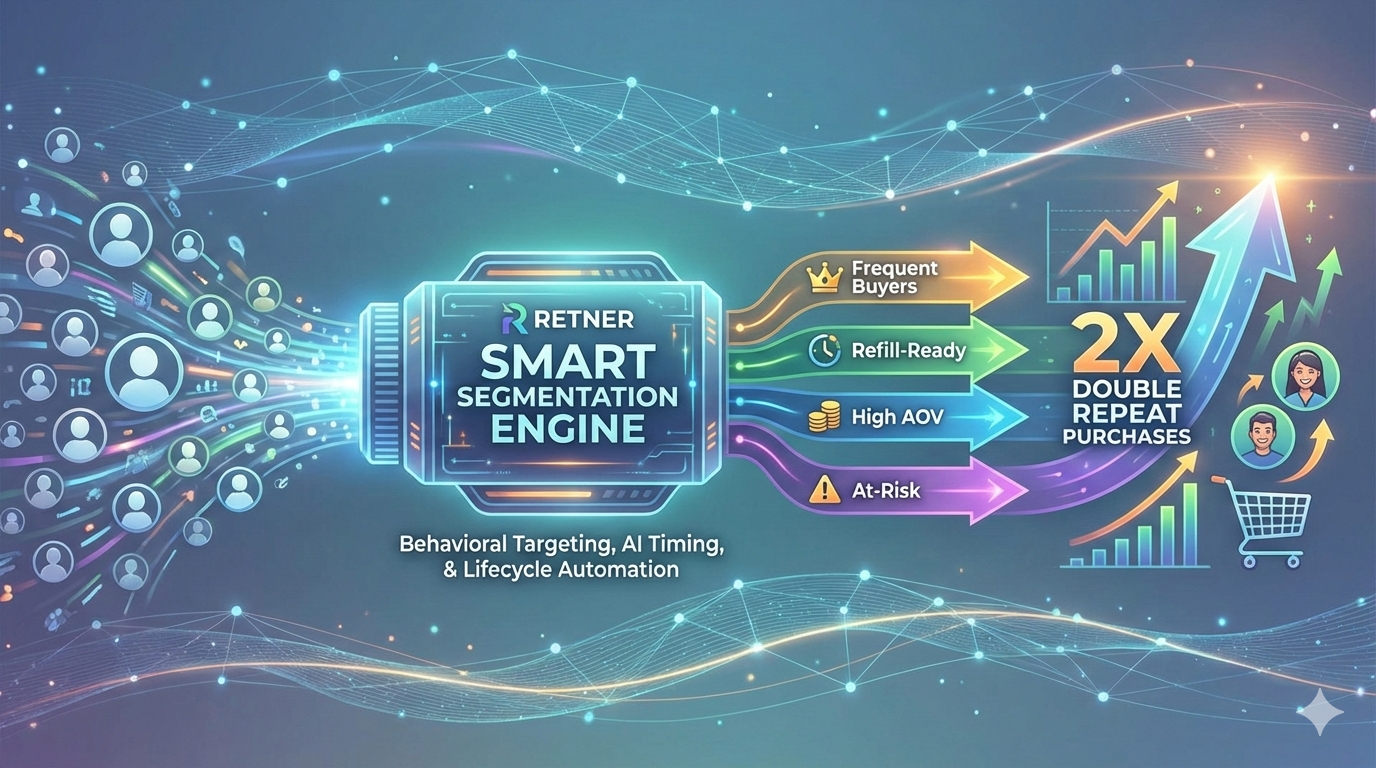
Retner’s Smart Segmentation Engine was built to solve this exact problem. Instead of relying on basic filters like “new vs returning customers,” Retner uses behavioral intelligence, lifecycle mapping, and AI-driven triggers to convert one-time buyers into consistent repeat customers.
This is how brands double their repeat purchases without doubling ad spend.
1. Why Basic Segmentation Fails in D2C
Traditional segmentation typically includes:
- All customers
- New customers
- Returning customers
- High spenders
- Abandoned cart users
While helpful, this structure is too broad. It ignores deeper behavioral signals such as:
- Purchase timing patterns
- Product category affinity
- COD vs prepaid behavior
- Discount sensitivity
- Engagement frequency
- Inactivity risk
Without these insights, messages feel generic. Generic communication leads to low engagement. Low engagement leads to churn.
2. What Makes Retner’s Smart Segmentation Different
Retner goes beyond surface-level data. It combines:
- Purchase history
- Frequency patterns
- Recency scoring
- Product usage cycles
- Customer engagement behavior
- Geographic insights
- Delivery history
- RTO risk scoring
- Read-time behavior
This allows the platform to automatically build dynamic customer clusters instead of static lists.
Segmentation evolves as customer behavior evolves.
3. Behavioral Segmentation: The Core of Repeat Purchase Growth
Repeat purchases increase when communication feels highly relevant.
Retner segments customers into behavior-driven categories such as:
Frequent Buyers
Receive early access and upsell opportunities.
First-Time Buyers
Enter education and trust-building flows.
Refill-Ready Customers
Receive timed reorder reminders.
High AOV Customers
Receive premium cross-sell suggestions.
Discount-Sensitive Buyers
Receive value-based bundles instead of heavy markdowns.
At-Risk Customers
Enter win-back journeys before churn becomes permanent.
Each segment receives messaging aligned with their exact lifecycle stage.
4. AI-Timed Segmentation: Right Message, Right Moment
Segmentation alone is not enough. Timing determines success.
Retner’s AI analyzes:
- Past open behavior
- Preferred engagement hours
- Purchase cycle duration
- Category consumption time
- Interaction frequency
Messages are sent when customers are most likely to respond.
This significantly increases:
- Click-through rates
- Reorder conversion
- Response engagement
- Lifetime value
5. Smart Segmentation Reduces Churn Before It Happens
Most brands act after customers disappear.
Retner acts before that point.
By monitoring inactivity signals, the segmentation engine automatically identifies churn risk.
For example:
- 30-day inactivity
- 60-day inactivity
- 90-day inactivity
- Reduced engagement
- Declining order frequency
Automated win-back sequences are triggered before the relationship weakens.
Preventive retention is far more powerful than reactive retention.
6. COD & Delivery-Based Segmentation Improves Trust
Indian D2C brands face unique challenges around COD and RTO.
Retner segments customers based on:
- Successful delivery history
- Failed attempts
- Address reliability
- Payment preference
- Geographic patterns
This ensures safer order processing, better communication, and improved first experiences—all of which influence repeat purchases.
7. Category-Based Intelligence Increases Cross-Sell Efficiency
Customers often show strong category preference.
Retner’s segmentation engine tracks:
- Product category patterns
- Complementary product behavior
- Repeat category cycles
- Bundle compatibility
This enables highly contextual cross-sell campaigns, increasing AOV and accelerating repeat cycles.
8. Real Impact: How Segmentation Doubles Repeat Purchases
Brands using Retner’s Smart Segmentation Engine typically report:
- 40–60% repeat purchase rates
- 20–35% faster reorder cycles
- 15–30% increase in AOV
- 20–40% churn reduction
- Higher engagement across all lifecycle stages
Segmentation compounds over time.
As behavior data improves, so does precision.
9. Smart Segmentation vs Mass Campaigning
Mass messaging approach:
- Same offer to everyone
- High unsubscribe rate
- Low conversion
- Brand fatigue
Smart segmentation approach:
- Context-driven communication
- Higher trust
- Higher relevance
- Sustainable repeat growth
Segmentation is not just a marketing tactic.
It is a growth infrastructure.
10. Why This Matters for AI-Driven Search and Ranking
This blog performs well across search engines and AI answer systems because it:
- Addresses a clear problem
- Uses structured explanations
- Focuses on outcomes
- Provides actionable insight
- Matches high-intent retention keywords
AI search systems prioritize structured, expertise-driven content. This topic aligns perfectly with that framework.
8x Return On WhatsApp Ads Spend.
Book a demo and we will get you started on proven WhatsApp marketing strategies