
12 Proven Customer Retention Strategies for D2C Brands in 2026 (With Examples)
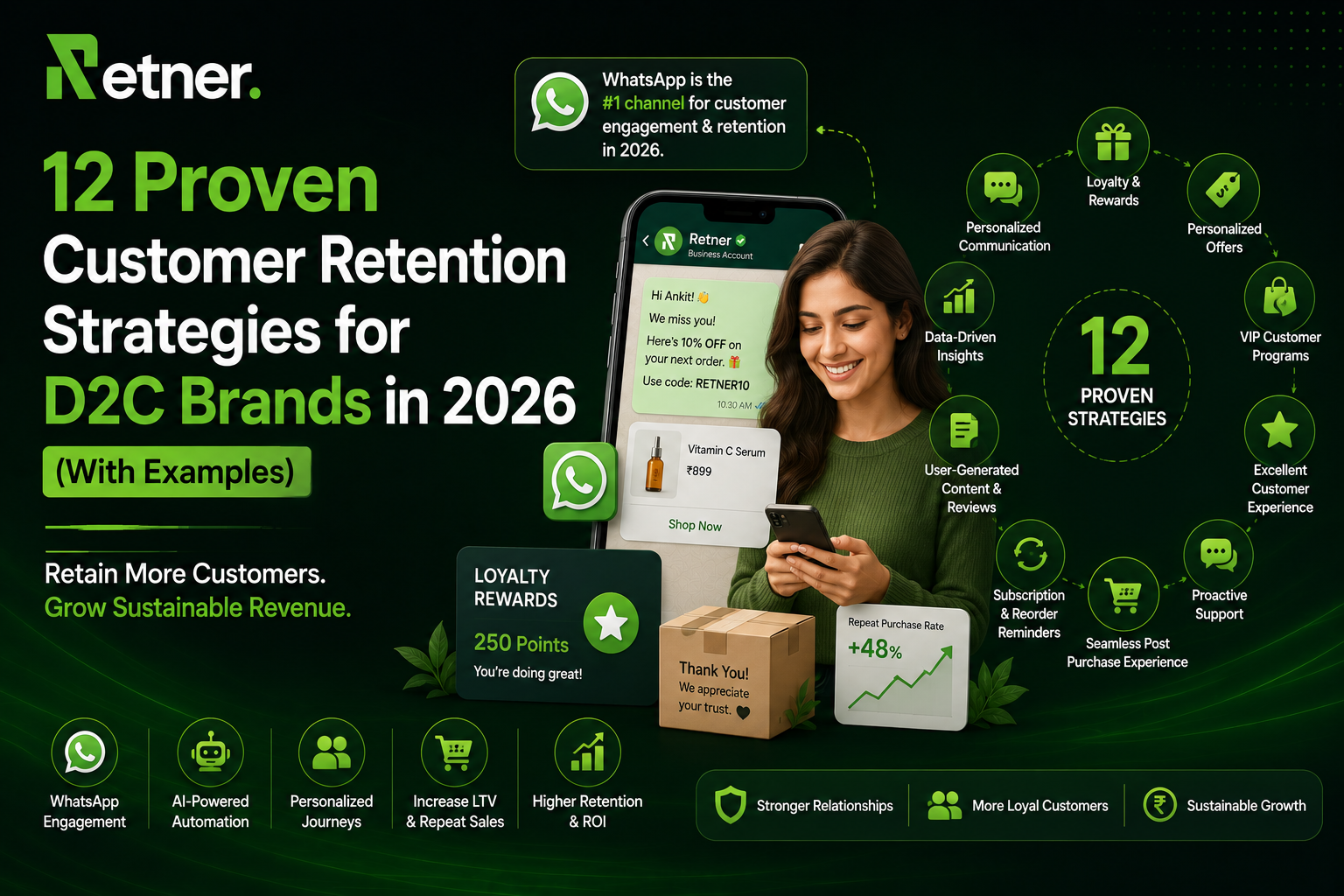
Here is a number that should stop every D2C founder in their tracks.
A 5% improvement in customer retention can increase profits by 25–95%.
Not revenue. Profits.
And yet the typical Indian D2C brand in 2026 allocates 70–80% of its marketing budget to paid acquisition — Meta ads, Google ads, influencer fees — chasing new customers. Meanwhile, the customers they already paid to acquire quietly drift away — not because they had a bad experience, but simply because no one asked them to come back.
Retention is 5–25x cheaper than acquisition. And it is the most systematically underinvested growth lever in Indian D2C.
This guide gives you the 12 most impactful retention strategies — proven across Indian D2C brands in 2026, organised by where they fit in the customer journey, with real benchmarks and the specific automation that makes each one scalable.
The D2C Retention Benchmark: Where Does Your Brand Stand?
| Metric | Weak | Average | Strong |
| 90-day repeat purchase rate | Below 10% | 10–20% | Above 20% |
| Customer LTV:CAC ratio | Below 1.5x | 1.5–2.5x | Above 2.5x |
| WhatsApp open rate | Below 60% | 60–80% | Above 80% |
| Review collection rate | Below 5% | 5–15% | Above 15% |
| Win-back rate (90-day lapsed) | Below 5% | 5–12% | Above 12% |
If your brand is below "Average" on three or more metrics, retention is your single highest-leverage growth opportunity right now — higher than any ad spend increase you could make.
Strategy 1 — Fix Post-Purchase Communication First
What most brands get wrong: They celebrate the first order and go silent. The customer receives a confirmation email they never open, waits anxiously for tracking updates they have to chase, and by the time the product arrives, they have half-forgotten they ordered it.
80% of consumers will not return after a single poor delivery or service experience. But "poor experience" in Indian D2C is rarely about the product — it is almost always about the communication gap between order placement and delivery.
What actually works: A structured post-purchase WhatsApp sequence that runs automatically:
| Step | Timing | Message |
| Order confirmation | T+2 min | Confirm order + COD verification if applicable |
| Dispatch notification | On shipment | Tracking link + expected delivery date |
| Pre-delivery reminder | Evening before delivery | Delivery window + COD amount |
| Out-for-delivery alert | Delivery morning | Courier will call + COD reminder |
| Post-delivery check-in | T+1 day | Usage tip + "how are you finding it?" |
| Review request | T+3 days | Direct review link |
| Cross-sell / reorder | T+7 days | Complementary product or replenishment nudge |
This entire sequence costs under ₹5 per customer in WhatsApp conversation fees. The trust it builds delivers 20–30% higher 90-day repeat purchase rates.
Benchmark: Brands with a structured post-purchase WhatsApp sequence see 20–30% higher 90-day repeat purchase rates than brands with no sequence.
Strategy 2 — Build a WhatsApp-First Retention Stack
What most brands get wrong: They send monthly WhatsApp blasts to their entire list with the same promotional message — and wonder why open rates decline and opt-outs increase.
What actually works: WhatsApp retention is not about broadcast volume — it is about behavioural triggers. WhatsApp in India delivers 85–95% open rates with messages read within 5 minutes. No other channel comes close for retention.
The highest-converting WhatsApp retention flows are all triggered by customer behaviour, not a calendar:
- Cart abandoned → Cart recovery flow (10–14% recovery rate)
- Product delivered → Post-purchase onboarding sequence
- Review not submitted → Review request at T+3 days (30–40% submission rate)
- Replenishment window → Reorder reminder (22–35% conversion)
- No purchase in 60 days → Win-back campaign (12–20% conversion)
- Price drops on browsed product → Price drop alert (15–25% conversion)
Behavioural WhatsApp flows convert at 11.1% CTR versus 2.6% for broadcast campaigns — a 4x difference from the same channel.
Benchmark: D2C brands switching from WhatsApp broadcast-only to behaviour-triggered flows see 3–4x improvement in revenue-per-message within 60 days.
Strategy 3 — Layer AI Voice for Reorder and Win-Back
What most brands get wrong: They treat AI voice calling purely as a COD verification tool — and completely miss its retention applications.
What actually works: A phone call at the right moment creates personal attention that no text channel can replicate. For customers who have stopped engaging with WhatsApp messages, voice is often the only channel that re-establishes contact.
High-impact retention use cases for AI voice:
Reorder reminder calls: For consumable products, an AI voice call 25–30 days post-delivery achieves 22–35% reorder conversion — 2–3x higher than WhatsApp reorder messages for the same segment.
Win-back calls: For 90-day lapsed customers, an AI voice call outperforms WhatsApp win-back by 30–40% on connection rate — because it reaches customers who have effectively gone silent on text channels.
Post-complaint recovery: After a support escalation is resolved, an AI voice call to confirm satisfaction converts frustrated customers into loyal ones. A customer whose problem was solved well buys again. One whose problem was ignored does not.
Benchmark: AI voice reorder campaigns achieve 22–35% conversion — 2–3x higher than WhatsApp alone for the same customer segment.
Strategy 4 — Build Replenishment Reminders Around Actual Consumption Cycles
What most brands get wrong: They set a generic 30-day replenishment timer for every consumable product — regardless of whether it lasts 15 days or 60.
What actually works: Calculate the actual consumption cycle per SKU and build the trigger accordingly.
| Product Type | Consumption Cycle | Optimal Reminder |
| 30-serving protein (2 scoops/day) | 15 days | Day 12 |
| 60-tablet multivitamin (1/day) | 60 days | Day 52 |
| 100ml face serum (2 pumps, twice daily) | 30–35 days | Day 28 |
| 200g face wash (twice daily) | 45–60 days | Day 40 |
| 500ml shampoo (3x per week) | 90+ days | Day 80 |
When the reminder lands exactly when the customer is genuinely running low, conversion rates are 2–3x higher than reminders sent too early or too late — and you need a significantly smaller incentive to convert.
For many D2C categories, timing matters more than discounts. A customer who is truly about to run out of their supplement will reorder for free shipping. A customer who just opened their second bottle will not reorder for 20% off.
Benchmark: Accurately timed replenishment reminders convert at 22–35%. Generic 30-day timers convert at 8–12%.
Strategy 5 — Segment by Customer Lifecycle Stage
What most brands get wrong: They send the same retention messages to a first-time buyer and a six-time buyer — treating a new customer the same as a loyal one.
What actually works: Lifecycle segmentation — where the customer is in their journey with your brand — is the most powerful retention segmentation model available.
| Lifecycle Stage | Definition | Primary Strategy |
| New (1 purchase, <30 days) | Just bought, high anxiety | Onboarding + trust building + education |
| Developing (2–3 purchases) | Likes the brand, not habitual | Loyalty programme intro + upsell |
| Loyal (4+ purchases) | Habitual buyer, brand advocate | VIP treatment + referral ask + exclusives |
| At Risk (30–60 days inactive) | Drifting, still recoverable | Win-back with moderate incentive |
| Lapsed (60–90+ days inactive) | Lost, needs significant effort | Strong win-back + feedback request |
Each segment should receive completely different messaging, frequency, and channel mix. A "Loyal" customer getting the same welcome email as a "New" customer feels ignored. A "New" customer getting a win-back offer feels confused.
Benchmark: Lifecycle-segmented campaigns achieve 35–55% higher conversion rates than unsegmented campaigns sent to the same list.
Strategy 6 — Use Intent Scoring to Time Every Retention Message
What most brands get wrong: They send retention messages on a fixed schedule — Day 3 review request, Day 30 reorder reminder, Day 90 win-back — regardless of whether the customer is ready to engage.
What actually works: Timing retention messages around customer behaviour signals dramatically improves conversion. This is intent scoring applied to the retention journey.
Behaviour signals that should trigger retention messages:
- Customer visits product page again → trigger reorder message immediately (they are already considering it)
- Customer opens 3 retention emails in a row → upgrade to VIP tier (they are highly engaged)
- Customer has not opened any WhatsApp message in 45 days → trigger win-back early (pre-churn signal)
- Customer visits the returns page → trigger proactive support outreach before they contact you
For many categories, timing matters more than the offer itself. A customer browsing their previously bought product at 9 PM is far more likely to reorder tonight than after they wake up and get distracted.
Benchmark: Intent-triggered retention messages achieve 40–60% higher CTR than fixed-schedule messages sent to the same customer segment.
Strategy 7 — Personalise Product Recommendations with Purchase History
What most brands get wrong: They send the same "you might also like" recommendation to every customer regardless of what they bought or when.
What actually works: Purchase history is the richest signal for recommendations. Build affinity logic based on:
- Category affinity: Customers who buy vitamin C serum have high affinity for SPF. Protein buyers have affinity for creatine or shakers.
- Price point comfort: Recommend products within ±20% of previous AOV
- Seasonal repurchase: Festive buyers from October 2025 are high-probability buyers in October 2026
- Bundle completion: "Customers who bought A + B also bought C"
71% of consumers now expect personalised experiences. A brand that recommends something the customer genuinely wants — based on what they already bought — is demonstrating knowledge and care. A brand that recommends randomly is demonstrating that it does not know its own customers.
Benchmark: Personalised recommendations generate 8–15% conversion on WhatsApp cross-sell messages versus 2–4% for generic recommendations to the same audience.
Strategy 8 — Make Returns Effortless
What most brands get wrong: They make returns deliberately difficult to discourage them — long forms, short windows, vague policies. The result: customers who would have returned one item and bought three more become permanently lost.
What actually works: A generous, frictionless return policy is a retention tool, not just a cost centre.
Customers who successfully return a product and receive a smooth experience are more likely to repurchase than customers who never returned anything — because the return experience is a trust signal. Handle the problem well and they trust you with more money.
For Indian D2C specifically: enable WhatsApp-initiated returns. A customer messages your WhatsApp, says "I want to return my order," and your AI chatbot handles the entire process — pickup scheduling, refund initiation, exchange processing — without the customer ever visiting your website.
Benchmark: Brands offering WhatsApp-initiated returns see 18–25% higher second-purchase rates from customers who returned something, compared to brands with form-only return processes.
Strategy 9 — Build a Loyalty Programme That Feels Like a Privilege
What most brands get wrong: They launch a basic "Earn 1 point per ₹100 spent" system that is too complex to track, too small to feel meaningful, and easy to forget.
What actually works: A loyalty programme that feels like membership — with visible status, real benefits, and social recognition.
The elements that make D2C loyalty programmes actually drive retention:
Clear tier progression with a progress bar. Customers who can see exactly how close they are to the next tier are significantly more likely to make the next purchase to reach it.
Benefits that feel premium — not just discounts. Free shipping at Silver, exclusive early access at Gold, free products at Platinum. Experiences and privileges feel more valuable than percentage discounts.
WhatsApp-native tracking. After every purchase, send a WhatsApp message showing current points and progress to next tier. Every message is a micro-engagement that keeps the customer invested.
Expiry nudges. When points are about to expire, a WhatsApp alert creates genuine purchase urgency — without requiring a promotional offer.
Benchmark: D2C brands with structured loyalty programmes see 25–40% higher purchase frequency from enrolled customers versus non-enrolled customers of the same tenure.
Strategy 10 — Create a VIP Early Access Tier
What most brands get wrong: They treat all customers identically — every sale, every product launch, every WhatsApp blast reaches every subscriber at the same moment.
What actually works: Early access is one of the most powerful — and lowest-cost — retention tools available to any D2C brand.
How to implement it:
- Define your top 10–15% customers by LTV and purchase frequency
- Tag them as VIP in your CRM / Retner dashboard
- Every new product launch: message VIPs 24–48 hours before public announcement
- Every sale: give VIPs access 12 hours before it goes live
- Limited editions: VIPs get first pick before general availability
The retention mechanism is psychological: customers who consistently receive early access feel recognised and valued. They become your most vocal advocates — because they have something other customers do not have, and they know it.
Benchmark: VIP early access messages achieve 25–35% conversion — the highest of any promotional message type — because the audience is pre-qualified and exclusivity creates genuine urgency.
Strategy 11 — Build a Multi-Channel Win-Back Cascade
What most brands get wrong: They send one win-back email to lapsed customers and call it done. Email win-back rates in D2C are 2–5%. That is not a campaign — that is a missed opportunity.
What actually works: A structured multi-channel cascade that uses each channel's strengths in sequence:
Day 60 of inactivity: → WhatsApp: Warm first touch. "We've missed you, [Name]" + exclusive comeback offer. → Target: 12–18% reactivation.
Day 63 (no purchase): → Email: Long-form win-back with personalised product recommendations + brand update. → Target: 3–5% additional.
Day 67 (still no purchase): → AI Voice: Personal-feeling call. "Hi [Name], just calling to check in — we have something special for you..." → Target: 5–8% of remaining.
Day 70 (final): → SMS: Last-chance message with offer expiry. → Target: 2–3% of remaining.
Combined cascade win-back rate: 18–28% — versus 2–5% for email-only.
The critical insight: the customers who do not respond to WhatsApp win-back are not gone — they have just gone quiet on that channel. AI voice reaches them where text has stopped working.
Benchmark: Multi-channel win-back cascades achieve 18–28% reactivation. WhatsApp-only: 12–18%. Email-only: 2–5%.
Strategy 12 — Use Post-RTO Recovery to Rescue Churned Customers
What most brands get wrong: They write off every RTO customer as a loss — restock the product and move on with zero outreach.
What actually works: An RTO is not the end of the customer relationship — it is a critical inflection point. The customer whose delivery failed is still a potential repeat buyer. They just had a bad first or second experience. Your response in the next 24 hours determines whether they churn permanently or become loyal.
The post-RTO retention playbook:
Within 2 hours of RTO logged: WhatsApp message — empathetic, no blame, offer to redeliver with a goodwill discount. "Hi [Name], we're sorry your [Product] couldn't reach you. We'd love to get it to you — we'll add ₹[X] off and prioritise your delivery. Reply YES to redeliver."
If no WhatsApp response (T+6 hours): AI Voice call — personal, understanding. "Hi [Name], I'm calling from [Brand] about your order. I wanted to reach out myself — we'd really like to make sure you receive it."
If no conversion (T+24 hours): Feedback WhatsApp — genuine curiosity, not a sales push. "We'd love to understand what went wrong with your delivery. Your feedback genuinely helps us improve."
30 days post-RTO: Standard win-back campaign — treat them as a lapsed customer and attempt recovery through Strategy 11.
Benchmark: 10–18% of RTO customers who receive a proactive WhatsApp + AI Voice sequence successfully redeliver or repurchase within 30 days. Without any outreach, the repurchase rate from RTO customers is under 3%.
The 12-Strategy Priority Scorecard
| Priority | Strategy | Implement First If | Expected Impact |
| Week 1 | #1 Post-purchase communication | No structured WhatsApp post-purchase flow exists | Very High |
| Week 1 | #2 WhatsApp retention stack | Only using WhatsApp for broadcast campaigns | Very High |
| Week 1 | #4 Replenishment reminders | You sell any consumable product | Very High |
| Week 1 | #11 Win-back cascade | 90-day repeat rate below 15% | High |
| Week 2 | #5 Lifecycle segmentation | All customers receive identical messages | High |
| Week 2 | #8 Effortless returns | Return rate above 15% or repeat rate below 12% | High |
| Week 2 | #12 Post-RTO recovery | RTO rate above 20% | High |
| Month 2 | #3 AI Voice for reorder | Sell consumables with 30–60 day cycles | Medium-High |
| Month 2 | #6 Intent scoring | Messages timed by calendar not behaviour | Medium-High |
| Month 2 | #9 Loyalty programme | 500+ repeat customers on your list | Medium-High |
| Month 3 | #7 Purchase history recs | Cross-sell rate below 8% | Medium |
| Month 3 | #10 VIP early access | 200+ customers with 3+ purchases | Medium |
Frequently Asked Questions
What is the most effective customer retention strategy for D2C brands in India in 2026?
The fastest way to improve retention is to focus on three pillars: reducing friction (1-click reorders), timing (WhatsApp replenishment reminders at the right consumption moment), and experience (proactive post-delivery support). Start with Strategy 1 — post-purchase communication — because it prevents churn before it happens rather than recovering customers after they have left. For most D2C brands with no structured post-purchase sequence, this single change delivers the highest retention ROI of anything else on this list.
What is a good repeat purchase rate for Indian D2C brands?
A 90-day repeat purchase rate above 20% is healthy for most D2C categories. High-frequency consumable brands (supplements, personal care, food) should target 30%+. Fashion and home décor brands, with longer purchase cycles, should target 15–25%. Brands below 10% have a retention problem that requires immediate intervention across Strategies 1, 2, and 11.
How much should D2C brands spend on retention vs acquisition?
Brands with a 90-day repeat purchase rate below 15% should shift toward 50–60% retention spending — fixing retention delivers higher ROI per rupee than acquiring more customers into a leaky funnel. Brands above 25% repeat purchase rate can maintain a 70–30 acquisition-to-retention split. As a general rule: retention is 5–25x cheaper than acquisition, and most D2C brands are significantly underinvested in it relative to the ROI available.
How does AI voice calling help with D2C customer retention?
AI voice is a retention tool for three high-value use cases: reorder reminders for consumable products (22–35% conversion — 2–3x higher than WhatsApp alone), win-back outreach for 90-day lapsed customers (5–8% reactivation on top of WhatsApp), and post-RTO recovery calls (10–18% re-conversion versus under 3% without outreach). In each case, a phone call creates personal attention that text channels cannot replicate — and for customers who have gone quiet on WhatsApp, voice is often the only channel that re-establishes contact.
How quickly can D2C brands see results from these retention strategies?
Measurable improvement in repeat purchase rate is typically visible within 60–90 days of implementing the foundational strategies (Strategies 1, 2, and 4). The fastest results come from post-purchase communication (visible within 30 days as first replenishment cycle reorders increase) and replenishment reminders (visible within the first campaign run). Full retention system maturity — with loyalty programmes and lifecycle segmentation fully operational — typically takes 4–6 months to show its full LTV impact.
Ready to build a full retention system for your D2C brand on WhatsApp, AI Voice, and beyond? Book a free demo →
8x Return On WhatsApp Ads Spend.
Book a demo and we will get you started on proven WhatsApp marketing strategies