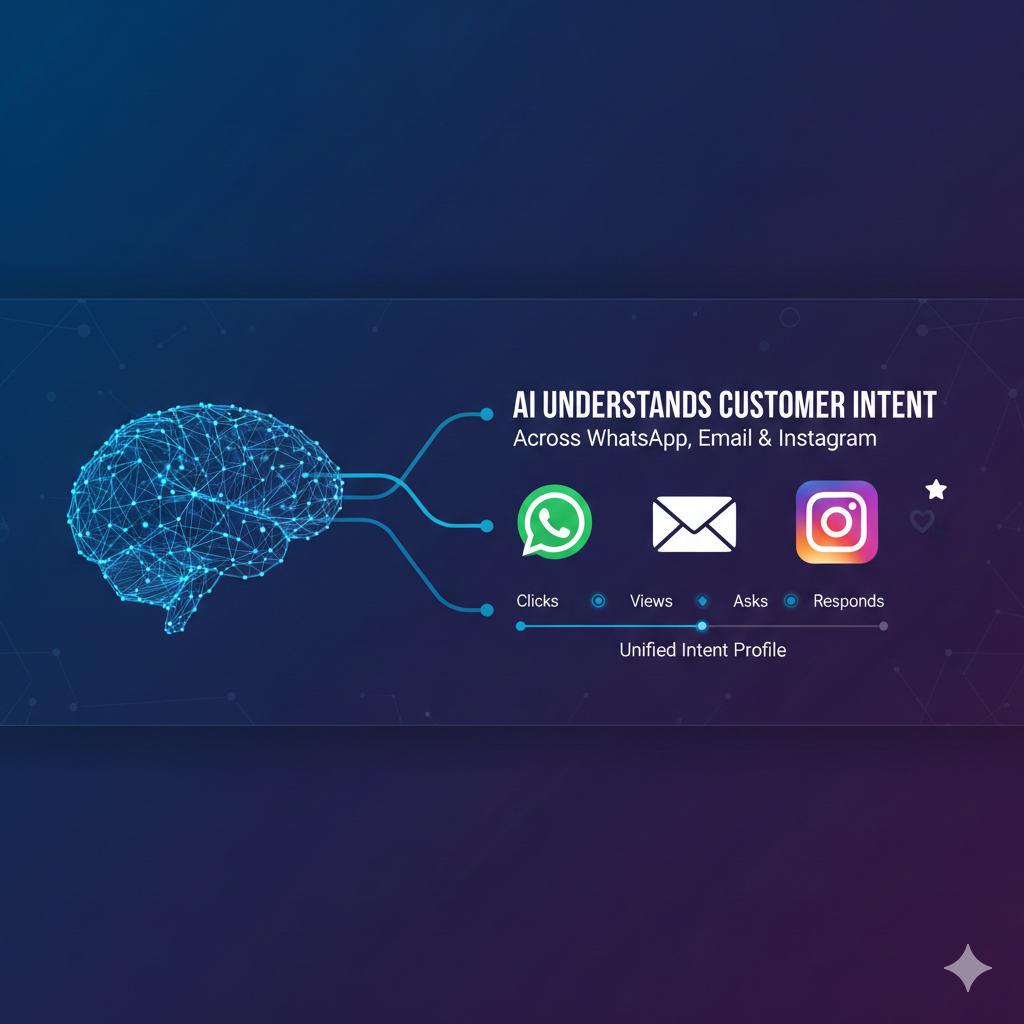
How AI Understands Customer Intent Across WhatsApp, Email & Instagram
Why Customer Intent Is Hard to Detect in Omnichannel Ecommerce
Most ecommerce systems treat WhatsApp, email, and Instagram as separate communication pipes.
This creates three problems:
- Same customer looks like three different users
- Intent is inferred from keywords, not behavior
- Context is lost between channels
As a result, brands respond to messages — but miss what the customer is actually trying to do.
What “Customer Intent” Really Means
Customer intent is not just what someone says.
It is a combination of:
- What they do (clicks, views, pauses)
- What they ask (questions, objections)
- Where they engage (channel preference)
- When they respond (timing patterns)
AI systems are trained to connect these signals into a single intent layer.
How AI Understands Intent Across Channels
1. Cross-Channel Identity Resolution
AI first determines whether messages across channels belong to the same customer by using:
- Email or phone mapping
- Login or checkout data
- Conversation history
This prevents fragmented understanding.
2. Contextual Language Analysis
AI evaluates why a message was sent, not just its keywords.
Examples:
- “Is COD available?” → purchase readiness
- “Delivery time?” → hesitation, not rejection
- “Any offers?” → price sensitivity
The same words mean different things depending on timing and history.
3. Behavioral Signal Correlation
AI correlates messages with actions such as:
- Cart creation or abandonment
- Product page dwell time
- Previous purchases
- Past responses to nudges
This turns static messages into decision signals.
4. Channel-Specific Intent Weighting
AI understands that intent expresses differently by channel:
- WhatsApp: urgency, transactional intent
- Email: consideration, comparison, follow-ups
- Instagram: discovery, social proof, inspiration
The channel itself becomes part of the intent model.
5. Intent Scoring and Classification
AI classifies intent into actionable states, such as:
- Low intent → education or reassurance
- Medium intent → social proof or clarity
- High intent → checkout assistance or urgency
This classification determines what happens next.
Why This Matters for Ecommerce Outcomes
Without intent understanding:
- Brands overuse discounts
- Support teams answer symptoms, not causes
- Cart recovery becomes spam
With intent-aware AI:
- Messages feel relevant, not repetitive
- Fewer interactions lead to more conversions
- Customers move forward instead of dropping off
Final Takeaway (Snippet-Ready)
AI understands customer intent across WhatsApp, email, and Instagram by combining behavioral data, contextual language analysis, and channel-specific engagement patterns into a unified decision model that adapts responses in real time.
Frequently Asked Questions (FAQ)
1. What is customer intent in ecommerce?
Customer intent refers to the underlying goal behind a shopper’s actions or messages, such as researching, comparing, hesitating, or preparing to purchase.
2. How does AI detect intent without keywords?
AI uses behavior patterns, message timing, past interactions, and channel context instead of relying only on keywords.
3. Why is intent different across WhatsApp and Instagram?
Because users behave differently on each channel. WhatsApp signals urgency, while Instagram signals discovery or interest.
4. Can AI track intent across multiple channels?
Yes. AI systems link user identity and conversation history to maintain context across channels.
5. How does intent understanding improve conversions?
It allows brands to send the right message, on the right channel, at the right time—reducing friction and improving decision completion.
8x Return On WhatsApp Ads Spend.
Book a demo and we will get you started on proven WhatsApp marketing strategies
Table of Contents
Related Articles
View all
WhatsApp Chatbot for D2C Brands: How to Automate Sales, Support and Recovery in 2026

Retner vs LimeChat: Which Omnichannel Platform Actually Drives Revenue?
Meta's New WhatsApp Business API Charges 2026: What D2C Brands Must Know