
What is Omnichannel Marketing? A Complete Guide for Indian D2C Brands in 2026
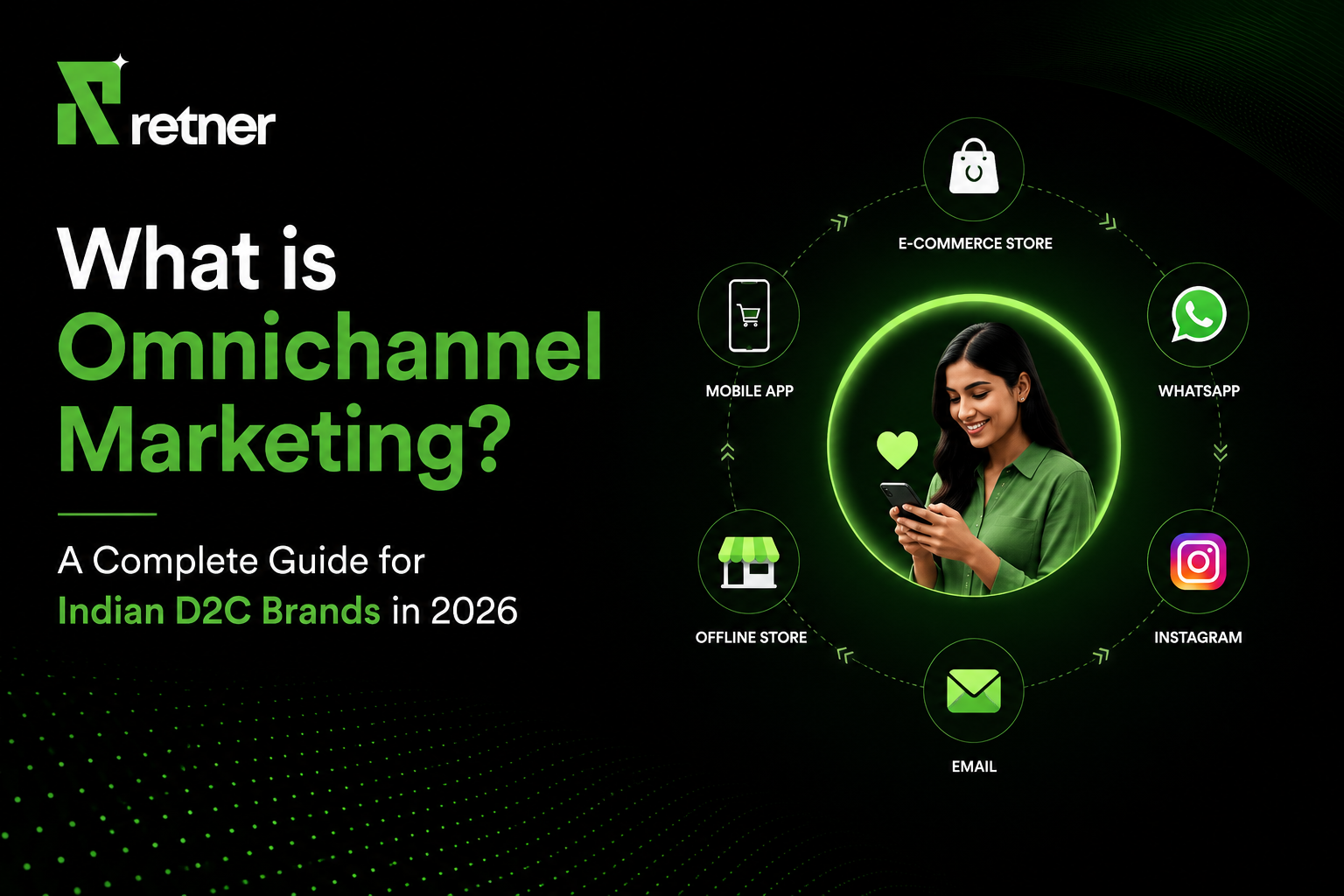
TABLE OF CONTENTS
- Why Global Omnichannel Guides Fail Indian D2C Brands
- What Is Omnichannel Marketing? (Definition)
- Omnichannel vs Multichannel: The Real Difference
- Why India D2C Needs a Different Omnichannel Model
- The 6 Omnichannel Channels for Indian D2C Brands (And What Each One Does)
- What Is Intent Scoring — The Intelligence Layer No One Talks About
- The 5-Stage Omnichannel Customer Journey for D2C
- 3 Real Omnichannel Flows Every D2C Brand Should Run
- India D2C Omnichannel Benchmarks for 2026
- How to Build an Omnichannel System in 30 Days
- How Retner Powers Omnichannel for Indian D2C Brands
- Frequently Asked Questions
Most guides on omnichannel marketing start with a Starbucks or Disney example.
A customer orders on the Starbucks app, earns loyalty points, picks up in-store, and receives a personalised email later. Seamless. Consistent. Omnichannel.
It is a clean example. And it is almost completely irrelevant to an Indian D2C brand doing ₹30 lakh a month on Shopify.
Because the Indian D2C reality looks nothing like a Starbucks case study.
Your customer discovered your brand on Instagram Reels. They placed a COD order at 11 PM. They have not opened a single email from you. They use WhatsApp for everything. And if your delivery arrives without adequate communication, there is a 30% chance they will refuse it at the door.
That is the world Indian D2C founders actually operate in. And that is the world this guide is written for.
This is not a generic omnichannel marketing explainer. This is the India-specific, WhatsApp-first, intent-driven omnichannel framework that brands doing ₹10 lakh to ₹5 crore a month actually need — built around the channels Indian customers use, the payment realities Indian brands face, and the tools available in 2026.
1. What Is Omnichannel Marketing?
Omnichannel marketing is a customer engagement strategy where a brand communicates with its customers across multiple channels — WhatsApp, email, SMS, voice, Instagram, and push notifications — in a coordinated, connected way, so that every interaction feels continuous and personalised regardless of where the customer is.
The defining characteristic of omnichannel is not the number of channels you use. It is whether those channels share context.
In a true omnichannel system, when a customer abandons a cart on your website, your WhatsApp automation knows about it. When a customer does not respond to the WhatsApp message, the system knows to try SMS next. When they receive an AI voice call and confirm their COD order, the entire subsequent communication flow updates accordingly.
Every channel is aware of what every other channel is doing. That shared awareness is what makes it omnichannel — and what makes it dramatically more effective than using channels in isolation.
2. Omnichannel vs Multichannel: The Real Difference
This is the most misunderstood concept in D2C marketing today. Most brands think they are doing omnichannel. Most are actually doing multichannel — and paying the price in customer experience and conversion rates.
| Factor | Multichannel | Omnichannel |
| Channel operation | Each channel runs independently | All channels share data and context |
| Customer experience | Inconsistent across channels | Seamless and continuous |
| Data flow | Siloed per channel | Unified customer profile |
| Messaging | Same message sent everywhere | Message adapts based on channel history |
| Triggering | Manual, scheduled | Automated, behaviour-triggered |
| What customer feels | Bombarded from multiple directions | Brand "gets them" wherever they are |
| Example | WhatsApp blast + email campaign run separately | Cart abandoned → WhatsApp fires → no response → SMS → no response → AI voice call |
| Outcome | Overlapping, fatigue-inducing | Coordinated, contextually timed |
The simplest test: If a customer gets the same abandoned cart message on WhatsApp and email within 10 minutes of each other — you are multichannel. If the email only fires because the customer did not open the WhatsApp message — you are omnichannel.
3. Why India D2C Needs a Different Omnichannel Model
Every major guide on omnichannel marketing is written with Western markets in mind. They build their frameworks around email as the primary channel, credit card payments as the default, and customers with strong brand trust as the starting assumption.
Indian D2C operates on fundamentally different ground. Understanding these differences is what separates a working omnichannel strategy from one that sounds good on paper but delivers nothing.
India Is a WhatsApp-First Economy
India has over 500 million WhatsApp users. Your customers check WhatsApp before they check email. They respond to WhatsApp messages in minutes. They ignore emails for days.
Any omnichannel strategy for Indian D2C that treats email as the primary engagement channel and WhatsApp as supplementary is built upside down. In India, WhatsApp is the backbone. Everything else supports it.
COD Dominates — and Changes Everything
Approximately 60–65% of Indian ecommerce orders are still COD. This single fact reshapes the entire customer journey.
A COD order is fundamentally different from a prepaid order. The customer has made zero financial commitment. Their intent at the time of placing the order may be genuine — but by the time the delivery arrives three to five days later, life has moved on. The excitement faded. The size doubt grew. And your brand has sent them nothing in between.
This is why India's average RTO rate is 20–40%. It is not primarily a logistics problem. It is an omnichannel communication problem. Brands that stay connected with the customer between order placement and delivery see dramatically lower RTO rates.
Anonymous Visitors Are the Majority
On most Indian D2C websites, 90–97% of visitors leave without identifying themselves. They browse, they consider, they abandon — and they are gone with no way to follow up.
Western omnichannel tools are built around known customers in a CRM. Indian D2C brands need omnichannel systems that can identify and engage visitors before they become customers — or they are ignoring their largest revenue opportunity.
Mobile-Only, Tier 2 and Tier 3 Buyers
Over 80% of Indian ecommerce traffic is mobile. A large and fast-growing segment of D2C buyers comes from Tier 2 and Tier 3 cities — Jaipur, Surat, Indore, Lucknow, Vadodara — where internet is primarily via mobile data, COD is the only trusted payment option, and brand communication via WhatsApp is expected.
These buyers do not engage with push notifications or email. They engage with WhatsApp, sometimes with Hindi or regional-language messages. Any omnichannel strategy that does not account for this audience is leaving its fastest-growing segment underserved.
4. The 6 Omnichannel Channels for Indian D2C Brands
An effective omnichannel stack for Indian D2C is not about using every channel simultaneously. It is about knowing what each channel does best — and building a coordinated system where each one plays its role.
Channel 1: WhatsApp — The Primary Engagement Layer
WhatsApp is the most powerful channel in the Indian D2C stack. It has the highest open rates (85–95%), the fastest response times, and the highest trust factor among Indian buyers.
What WhatsApp does best in an omnichannel system:
- Order confirmations and COD-to-prepaid conversion offers
- Cart abandonment recovery (first touchpoint)
- Pre-delivery reminders and address verification
- Post-purchase review collection and upsells
- Reorder reminders at the right point in the consumption cycle
- Product Q&A and real-time support via AI chatbot
WhatsApp should be the first channel that fires in most D2C automation flows — and the fallback when other channels fail.
Channel 2: AI Voice — The COD Verification and Recovery Channel
AI voice calling is the most underused channel in Indian D2C — and arguably the highest-impact one for brands with significant COD volumes.
An AI voice agent calls a COD customer within minutes of order placement to confirm intent, verify the delivery address, and offer a COD-to-prepaid incentive. The call takes 60–90 seconds, sounds human, and requires zero manual effort.
What AI voice does best in an omnichannel system:
- COD order verification before dispatch (reduces RTO by 20–40%)
- NDR recovery — when a delivery attempt fails and WhatsApp gets no response
- Post-RTO win-back outreach
- High-value customer re-engagement when other channels have gone quiet
Voice reaches customers who do not check WhatsApp immediately. In an omnichannel cascade, it often fires third — after WhatsApp and SMS have not received a response — but it is frequently the touchpoint that closes the loop.
Channel 3: Instagram DMs — The Discovery-to-Purchase Channel
Instagram is where discovery happens for Indian D2C. A customer sees a Reel, comments, or taps a story — and an omnichannel system should be able to continue that conversation automatically in their DMs.
What Instagram DMs do best in an omnichannel system:
- Comment-to-DM flows (customer comments on a Reel → instant DM with product link)
- Story reply automation (customer replies to a story → personalised follow-up DM)
- Abandoned cart recovery for customers more active on Instagram than WhatsApp
- New product launch DM sequences for engaged followers
- Product recommendation flows via DM quiz
Instagram DMs work especially well for fashion, beauty, and lifestyle D2C brands where discovery and aspiration drive purchase decisions.
Channel 4: SMS — The Reach-Everywhere Fallback
SMS has lower engagement than WhatsApp but near-universal reach. Even customers without internet connectivity can receive an SMS. For time-sensitive communication — delivery alerts, OTPs, flash sale notifications — SMS is irreplaceable.
What SMS does best in an omnichannel system:
- Delivery day alerts for customers with low WhatsApp engagement
- Last-chance offers during flash sales
- NDR notifications when a delivery attempt fails
- Reaching customers in areas with poor internet connectivity
- High-urgency triggers where instant delivery matters more than rich media
In an omnichannel cascade, SMS often fires second — when WhatsApp has been delivered but not opened within a defined time window.
Channel 5: Email — The Trust and Documentation Channel
Email is the lowest-priority channel for most Indian D2C customers in terms of real-time engagement. Open rates average 15–25% versus 85–95% for WhatsApp. But email is not without value — it plays a specific role in the omnichannel stack.
What email does best in an omnichannel system:
- Order confirmation documentation (customers screenshot these)
- Policy information — return, exchange, shipping terms
- Long-form product education content for high-consideration categories (supplements, skincare)
- Re-engagement for lapsed customers (combined with WhatsApp)
- Win-back campaigns for customers who have unsubscribed from WhatsApp
In an omnichannel strategy for India, email is a supporting channel, not the lead. Configure it to fire after WhatsApp has had first contact, or for documentation-type communication where format matters.
Channel 6: Push Notifications — The App and Web Engagement Channel
Web and app push notifications are the fastest-declining channel in D2C engagement — opt-out rates are high and relevance is low for most brands. However, for brands with a loyal app user base, push remains valuable.
What push does best in an omnichannel system:
- Flash sale alerts for active app users
- Back-in-stock notifications for wishlisted products
- Loyalty point updates and reward milestones
- Real-time delivery tracking updates inside the app
In an omnichannel stack, push is a supplementary layer for engaged, app-active customers — not a primary acquisition or recovery tool.
5. What Is Intent Scoring — The Intelligence Layer No One Talks About
Most D2C brands run omnichannel campaigns in the dark. They do not know whether a visitor is about to buy or just browsing. They do not know whether a COD order is high-risk or low-risk. They do not know which customer is about to churn.
Intent scoring is the AI-powered process of analysing a visitor's or customer's behaviour across your website and channels — and assigning a buying intent score (Low, Medium, High) that determines when and how to engage them.
Instead of sending the same WhatsApp message to every customer who abandoned a cart, intent scoring means:
- A high-intent visitor (spent 4+ minutes on the product page, checked size guide, added to cart, started checkout) gets an immediate WhatsApp message with a direct buy link.
- A medium-intent visitor (browsed 3 products, spent 90 seconds, did not add to cart) gets a softer engagement — a product recommendation message 2 hours later.
- A low-intent visitor (landed from an ad, bounced in 30 seconds) gets no message — because the cost of engagement does not justify the probability of conversion.
Intent scoring transforms omnichannel from a message-delivery system into a decision intelligence system. Every touchpoint is earned by the customer's own behaviour — which means messages feel relevant rather than intrusive, and engagement rates increase dramatically.
Signals that feed intent scoring for D2C brands:
- Time spent on product page
- Number of products browsed in a session
- Return visits within 24–72 hours
- Scroll depth on product and category pages
- Cart additions and removals
- Checkout initiation and abandonment
- Device type and traffic source
- Time of visit and session frequency
- Past purchase history and average order value
6. The 5-Stage Omnichannel Customer Journey for D2C
A complete omnichannel system for Indian D2C does not start at cart abandonment. It starts at the moment a visitor lands on your website — even before they have done anything at all.
Stage 1: Identify
The question: Who is on your website right now?
Most analytics tools tell you traffic volume. Omnichannel systems go further — they identify individual visitors using device fingerprinting, behavioural signals, and customer data matching.
A visitor who has previously transacted with you on WhatsApp can be recognised as a known customer the moment they land on your website — even without logging in. This allows personalised engagement from the very first second of a new session.
For new, anonymous visitors, identification happens progressively through engagement — a WhatsApp widget interaction, a spin-the-wheel opt-in, or a comment-to-DM flow that captures their number.
Stage 2: Engage
The question: Which channel, which message, and when?
High-intent visitors get immediate, direct engagement on the channel most likely to reach them — typically WhatsApp for most Indian D2C customers. Medium-intent visitors get a softer, educational touchpoint. Low-intent visitors are observed further before engagement.
The engagement is personalised to the product they were looking at, the question they might have, and the stage of the journey they are in. It is not a broadcast. It is a one-to-one conversation triggered by their specific behaviour.
Stage 3: Convert
The question: What removes the last barrier to purchase?
Once a customer is engaged, conversion requires removing whatever is stopping them. For some, it is a size question. For others, it is a delivery time concern. For COD customers, it may be uncertainty about the brand.
An omnichannel conversion system handles this through AI chatbot support, personalised product recommendations, real-time order tracking, and COD-to-prepaid conversion offers — all in the same conversation thread, across whichever channel the customer responds on.
Stage 4: Retain
The question: How do we make this customer come back?
Retention is where omnichannel earns its real ROI. A coordinated post-purchase journey — order confirmation on WhatsApp, delivery update via SMS, review request three days after delivery, reorder reminder at the right point in the consumption cycle, and a loyalty reward notification on push — turns a one-time buyer into a repeat customer automatically.
The customer does not experience this as automation. They experience it as a brand that knows them, communicates with them at the right time, and makes reordering effortless.
7. Three Real Omnichannel Flows Every D2C Brand Should Run
Flow 1: Abandoned Cart Recovery (5-Channel Cascade)
Trigger: Customer adds product to cart but does not complete purchase.
| Step | Channel | Timing | Message |
| 1 | 30 min after abandon | "Hey [Name], you left something in your cart! Your [Product] is waiting. Grab it before it sells out → [Link]" | |
| 2 | 2 hours if WhatsApp unread | Abandoned cart email with product image and review social proof | |
| 3 | SMS | 6 hours if no action | "Your cart expires soon. Complete your order and get [Offer] → [Short Link]" |
| 4 | Instagram DM | Next day if Instagram-active | "Saw you were checking out [Product] — any questions before you decide? We're here." |
| 5 | Push | 48 hours for app users | "Back in stock alert — your saved item is still available." |
Result: Brands running a 5-channel cascade consistently recover 2–3x more revenue than single-channel WhatsApp-only flows.
Flow 2: COD Order → RTO Prevention (3-Channel Verification)
Trigger: Customer places a COD order.
| Step | Channel | Timing | Action |
| 1 | Immediately | Order confirmation + COD-to-prepaid offer (₹30 off if you pay now) | |
| 2 | AI Voice | 20 min if no WhatsApp response | AI agent calls customer, confirms order and address, offers prepaid conversion |
| 3 | Day before delivery | "Your order arrives tomorrow! Please ensure someone is home at [Address]. Reply '2' to reschedule." | |
| 4 | SMS | Delivery morning | "Your [Brand] order is out for delivery today. Our courier will call you. Thank you!" |
Result: Brands running this flow see 25–40% reduction in COD RTO within 60 days of activation.
Flow 3: Post-Purchase Retention (Repeat Revenue Engine)
Trigger: Order delivered successfully.
| Step | Channel | Timing | Message |
| 1 | 1 day post-delivery | "How's your [Product] treating you? 😊 Share your first impressions — we'd love to hear!" | |
| 2 | 3 days post-delivery | Detailed product usage guide + complementary product recommendations | |
| 3 | 7 days post-delivery | Review request with direct link to Google/platform + 50-point loyalty reward offer | |
| 4 | Based on product cycle | "Time to restock? Your [Product] typically runs out around now. Reorder with 10% off → [Link]" | |
| 5 | Push | Next product launch | "New launch alert: You loved [Product], you'll love this." |
Result: Brands running a post-purchase retention flow see 20–35% improvement in repeat purchase rate within 90 days.
8. India D2C Omnichannel Benchmarks for 2026
Use these benchmarks to audit your current channel performance and identify where to focus.
Channel Performance Benchmarks
| Channel | Average Open Rate | Average CTR | Average Response Rate | Best Use Case |
| 85–95% | 25–40% | 15–25% | Cart recovery, COD confirmation, retention | |
| AI Voice | N/A (calls) | N/A | 55–70% answer rate | COD verification, NDR recovery |
| SMS | 70–85% | 8–15% | 3–8% | Delivery alerts, flash sales |
| Instagram DM | 80–90% (when triggered) | 20–35% | 12–20% | Product discovery, launch campaigns |
| 15–25% | 2–5% | 1–3% | Documentation, long-form education | |
| Push | 5–12% | 1–3% | N/A | App-active loyalty users |
RTO Benchmarks by Omnichannel Maturity
| Omnichannel Setup | Average RTO Rate |
| No post-order communication | 35–50% |
| WhatsApp confirmation only | 25–35% |
| WhatsApp + SMS + delivery reminder | 15–25% |
| WhatsApp + AI Voice + full omnichannel cascade | 8–15% |
Repeat Purchase Rate by Omnichannel Maturity
| Retention Setup | Average Repeat Rate (90-day) |
| No retention automation | 8–12% |
| Email-only sequences | 12–18% |
| WhatsApp-only sequences | 18–28% |
| Full omnichannel post-purchase journey | 30–45% |
9. How to Build an Omnichannel System in 30 Days
You do not need 6 months and an enterprise budget to go omnichannel. Here is a practical 30-day roadmap for D2C brands starting from scratch.
Week 1: Foundation
- Connect your Shopify store to an omnichannel platform
- Set up WhatsApp Business API (via a verified BSP)
- Map your current customer journey — where are the drop-offs?
- Identify your top 3 use cases: cart recovery, COD verification, or post-purchase retention
- Import your customer database and segment by purchase history
Week 2: WhatsApp-First Flows
- Build and activate your abandoned cart WhatsApp flow (3 messages over 24 hours)
- Set up COD order confirmation + prepaid conversion offer on WhatsApp
- Activate address verification message for all COD orders
- Set up pre-delivery reminder (day before + delivery day)
- Test every flow manually before going live
Week 3: Add the Second and Third Channels
- Activate SMS as a fallback for WhatsApp non-openers
- Set up AI voice calling for COD orders above a defined threshold (e.g., ₹500+)
- Connect Instagram DM automation for your active Instagram audience
- Build email flows for post-purchase product education
Week 4: Intelligence and Optimisation
- Review open rates, response rates, and conversion rates per channel
- Identify which flows are driving the most revenue recovery
- Begin intent scoring setup — define High, Medium, Low intent criteria for your brand
- A/B test WhatsApp message copy (personalised name vs generic, offer vs no offer)
- Review RTO rate change from Week 1 to Week 4
By Day 30, most brands have a working omnichannel system that is recovering abandoned carts, reducing RTO, and generating measurable incremental revenue — without adding headcount.
10. How Retner Powers Omnichannel for Indian D2C Brands
Retner is the only omnichannel engagement platform built from the ground up for Indian D2C brands — with the specific realities of WhatsApp-first communication, COD dominance, and Shopify integration at its core.
Here is what makes Retner different from generic global omnichannel tools:
Intent scoring built in. Retner's engine analyses 200+ micro-behaviour signals per visitor to assign real-time buying intent scores. High-intent visitors trigger immediate engagement. Low-intent visitors are observed without burning your message credits.
WhatsApp-first architecture. WhatsApp is not an integration in Retner — it is the backbone. Every automation flow is built WhatsApp-first, with other channels cascading intelligently based on engagement.
AI voice calling included. Retner's AI voice agent makes outbound calls for COD verification, NDR recovery, and post-RTO win-back — directly from the platform, with no third-party integration required.
Anonymous visitor identification. Retner identifies anonymous website visitors using behavioural and device signals — giving you a way to engage the 97% of visitors who leave without converting.
Native Shopify integration. Connect Retner to your Shopify store in minutes. Order data, customer history, product catalogue, and real-time cart activity all flow into Retner automatically.
6-channel orchestration in one dashboard. WhatsApp, AI Voice, Instagram DM, SMS, Email, and Push — all managed from a single platform, with unified customer profiles and coordinated campaign logic.
Brands using Retner's full omnichannel stack see average RTO reductions of 30–45%, repeat purchase rate improvements of 20–35%, and cart recovery revenue of ₹2–8 lakh per month depending on scale.
11. Frequently Asked Questions
What is omnichannel marketing in simple words?
Omnichannel marketing means reaching your customers on multiple channels — WhatsApp, email, SMS, Instagram, voice, and push — in a coordinated way where each channel knows what the others are doing. Instead of sending separate, disconnected campaigns on each platform, omnichannel creates a single, continuous customer experience regardless of where your customer engages.
What is the difference between omnichannel and multichannel marketing?
Multichannel marketing means being present on multiple channels, but each channel operates independently. Omnichannel marketing means all channels share customer data and coordinate with each other. In multichannel, a customer might receive the same abandoned cart message on both WhatsApp and email at the same time. In omnichannel, the email only fires if the WhatsApp message was not opened — because the system knows.
Which channels matter most for Indian D2C omnichannel marketing?
For Indian D2C brands, WhatsApp is the primary omnichannel channel by a significant margin — with 85–95% open rates versus 15–25% for email. AI voice calling is the second-most impactful channel for brands with significant COD volumes, reducing RTO by 20–40%. Instagram DMs, SMS, email, and push notifications play supporting roles in a full omnichannel stack.
How does omnichannel marketing reduce RTO for Indian D2C brands?
RTO is fundamentally a communication problem — customers place COD orders with low commitment, and brands fail to stay in touch between order and delivery. Omnichannel RTO reduction works by: confirming COD orders via WhatsApp immediately after placement, following up with an AI voice call if there is no response, verifying the delivery address before dispatch, sending delivery reminders the day before arrival, and automating NDR recovery when a delivery attempt fails. Brands with this full flow in place typically achieve RTO rates of 8–15% versus the industry average of 20–40%.
Is omnichannel marketing only for large D2C brands?
No. Omnichannel marketing is particularly valuable for small and mid-sized D2C brands doing ₹10 lakh to ₹5 crore per month — because every recovered cart and every prevented RTO has a proportionally larger impact on a smaller brand's margin. With platforms like Retner, a Shopify brand doing 200 orders per month can be fully omnichannel within a week — without a tech team or enterprise budget.
What is intent scoring in omnichannel marketing?
Intent scoring is the process of analysing a visitor's behaviour on your website — time on product page, products browsed, scroll depth, return visits, cart activity — and assigning a buying intent score in real time. High-intent visitors trigger immediate, direct engagement. Low-intent visitors are observed without triggering engagement. Intent scoring ensures your omnichannel communications are sent when the probability of conversion is highest — reducing message fatigue and improving ROI.
How long does it take to see results from omnichannel marketing?
Most D2C brands see measurable results within 30–45 days of activating their omnichannel system. The fastest wins come from cart abandonment recovery (typically visible in Week 1) and COD verification via AI voice (RTO reduction visible within 2–3 weeks). Full omnichannel maturity — with intent scoring, multi-channel cascades, and post-purchase retention — typically delivers its full impact within 60–90 days.
Ready to build a WhatsApp-first omnichannel system for your D2C brand? See how Retner works — Book a free demo →
8x Return On WhatsApp Ads Spend.
Book a demo and we will get you started on proven WhatsApp marketing strategies