
What is RCS Messaging? A Complete Guide for D2C Brands in India (2026)
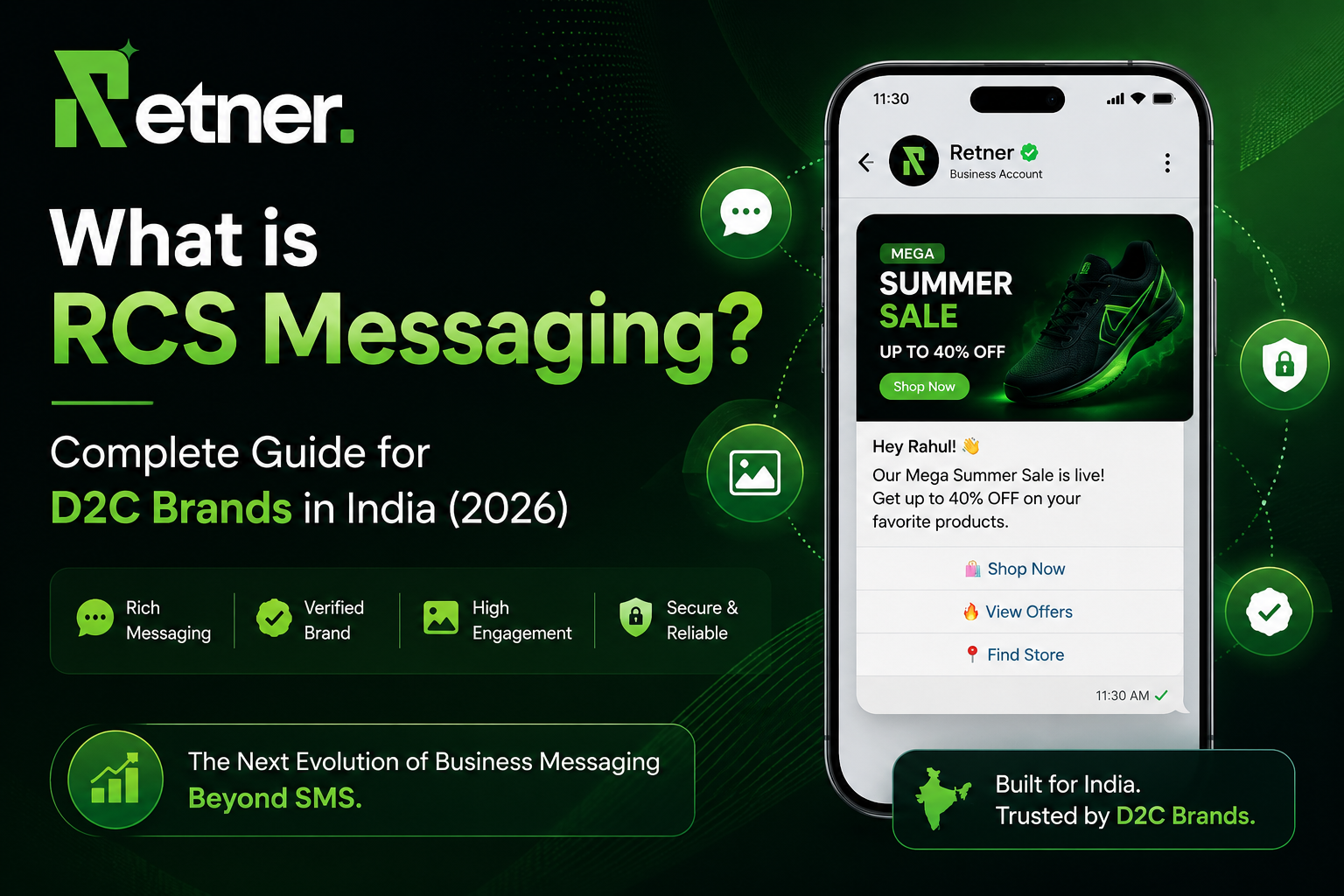
There is a messaging channel in your customer's phone right now that your competitors have almost certainly not set up.
It delivers WhatsApp-quality rich messages — images, carousels, interactive buttons, brand logos — without requiring the customer to have any app installed. It reaches 500 million Indian devices. It is supported by every major Indian carrier. It costs 40–60% less per message than WhatsApp. And in 2026, it is still being ignored by the vast majority of D2C brands in India.
It is called RCS — Rich Communication Services. And the window to be an early mover on this channel in Indian D2C is closing.
This guide explains exactly what RCS is, how it works, what it can do for your brand, how its costs compare to WhatsApp and SMS, and how to start using it as part of your D2C omnichannel strategy in 2026.
1. What Is RCS Messaging?
RCS (Rich Communication Services) is the next-generation successor to SMS — built directly into the default messaging app on Android and iPhone — that allows businesses to send branded, interactive messages with images, carousels, buttons, and read receipts, without requiring the customer to install any additional app.
<cite index="36-1">RCS stands for Rich Communication Services. It is the next-generation messaging protocol developed by the GSMA — the global mobile industry body — as a direct replacement for SMS.</cite>
Think of it this way:
- SMS = plain text, 160 characters, no images, no branding, easily spoofed
- WhatsApp = rich media, interactive, conversational — but requires app download and customer opt-in
- RCS = rich media, interactive, branded, verified — delivered through the phone's built-in messaging app, no extra app needed
<cite index="50-1">In simple terms, RCS turns your default SMS inbox into something that behaves a lot like WhatsApp or iMessage — just with operator backing and deep device-level integration.</cite>
When a D2C brand sends an RCS message to a customer, the customer sees it in the same inbox where they receive their regular SMS — but instead of plain text, they see your brand logo, a verified sender badge, a product image or carousel, and action buttons ("Track Order", "Complete Purchase", "Confirm COD").
No app. No download. No friction.
2. Why 2026 Is RCS's Tipping Point in India
RCS has existed for years. So why is 2026 the year D2C brands should care?
Three things happened simultaneously that changed everything:
All Three Major Carriers Are Now Fully On Board
<cite index="43-1">All three major operators — Jio, Airtel, and Vi — now fully support RCS Business Messaging across their networks, with coverage spanning more than 1,000 cities across India.</cite>
Until 2025, RCS had fragmented carrier support in India — some operators were partially live, others were still piloting. In 2026, that fragmentation is resolved. If your customer uses Jio, Airtel, or Vi — which covers virtually the entire Indian mobile subscriber base — they can receive RCS messages.
Apple Joined With iOS 18
For years, RCS was held back by one critical gap: iPhone users could not receive RCS messages. Apple refused to support the standard.
<cite index="43-1">Apple added native RCS support in iOS 18 in September 2024, closing the iPhone gap that had held the standard back for years.</cite>
This is significant even for India — where Android dominates — because premium urban customers (your high-AOV segment) are disproportionately iPhone users. RCS now reaches them too.
500+ Million Devices Are Already RCS-Ready
<cite index="43-1">Over 500 million Indian devices are RCS-ready — any Android phone on Android 5.0 or newer, plus iPhones on iOS 18 — giving businesses enormous native reach.</cite>
<cite index="44-1">RCS fills the gap perfectly — it works natively on Android phones, which account for 95%+ of Indian smartphones, and is supported by all major Indian carriers.</cite>
You do not need your customers to do anything. If they have an Android phone (which 95% of your customers do) and are on Jio, Airtel, or Vi (which nearly all of them are), they can receive your RCS messages right now.
3. How RCS Works — The Simple Explanation
Understanding how RCS works helps you use it correctly.
The Sending Side
You (the brand) send RCS messages through an RCS Business Messaging (RBM) platform — either directly or through a CPaaS provider. You create a verified Brand Agent — essentially your official business identity on RCS — that includes your company name, logo, verified badge, and contact information.
When you send a message, it is routed through Google's Jibe infrastructure and delivered via the carrier (Jio, Airtel, or Vi) to the customer's native messaging app.
The Receiving Side
The customer receives your message in the same app where they receive SMS — Google Messages on Android, or Messages on iOS 18+. The message looks nothing like a plain SMS. It has your brand logo in the sender field, a blue verified badge confirming your identity, and the full rich media content you sent — images, buttons, carousels.
The customer never left their default messaging app. They did not need to install anything. They did not need to opt into a third-party platform.
The Fallback
What happens if a customer's device or network cannot receive RCS?
<cite index="43-1">Automatic SMS fallback: When a device or network cannot receive RCS, the message automatically falls back to SMS — so your campaign still reaches 100% of your list, rich or plain.</cite>
This is a critical feature. Unlike WhatsApp, where a message simply fails if the customer does not have the app, RCS degrades gracefully to plain SMS — ensuring universal reach with zero manual intervention.
Verified Sender Identity
One of RCS's most important features for D2C is sender verification. Unlike SMS, where anyone can spoof a sender ID, <cite index="39-1">RCS Business Messaging allows customers to see exactly who sent a message before they read it — with Google-managed verification that is meaningfully stronger than the "trust the number" model SMS relies on.</cite>
For D2C brands, this builds immediate trust — especially for first-time buyers who might otherwise ignore an unknown number.
4. RCS Features: What You Can Send That SMS Cannot
| Feature SMS RCS WhatsApp | |||
| Plain text | ✅ | ✅ | ✅ |
| Character limit | 160 | 1,600+ | None |
| Images and GIFs | ❌ | ✅ | ✅ |
| Product carousels | ❌ | ✅ | ✅ |
| Action buttons | ❌ | ✅ | ✅ (limited) |
| Quick replies | ❌ | ✅ | ✅ |
| Verified sender badge | ❌ | ✅ | ✅ |
| Brand logo in sender | ❌ | ✅ | ✅ |
| Read receipts | ❌ | ✅ | ✅ |
| Delivery receipts | Limited | ✅ | ✅ |
| Rich cards | ❌ | ✅ | ❌ |
| Suggested actions (maps, calls) | ❌ | ✅ | ❌ |
| No app install required | ✅ | ✅ | ❌ |
| No opt-in to a platform required | ✅ | ✅ | ❌ |
| Automatic SMS fallback | N/A | ✅ | ❌ |
The key differentiator between RCS and WhatsApp: RCS requires no platform opt-in. A customer who has never interacted with your brand on WhatsApp can still receive a rich, branded RCS message in their default messaging app — as long as they are on a supported carrier and device.
5. RCS vs SMS vs WhatsApp: Complete Comparison
| Factor SMS RCS WhatsApp Business | |||
| Requires app install | ❌ | ❌ | ✅ |
| Requires customer opt-in to platform | ❌ | ❌ | ✅ |
| Reach in India | ~100% (all mobile) | 500M+ devices (growing) | 500M+ users (opt-in needed) |
| Rich media (images, carousels) | ❌ | ✅ | ✅ |
| Action buttons | ❌ | ✅ | Limited |
| Verified sender identity | ❌ | ✅ | ✅ |
| Read receipts | ❌ | ✅ | ✅ |
| Cost per message (India) | ₹0.10–₹0.18 | ₹0.25–₹0.45 | ₹0.35–₹0.88/conversation |
| CTR (India benchmark) | 1–3% | 25–40% | 25–40% |
| Two-way conversation | ❌ | ✅ | ✅ |
| Fallback when unsupported | N/A | Auto-falls to SMS | Message fails |
| iOS support | ✅ | iOS 18+ (growing) | ✅ |
| Best for | Alerts, OTPs | Branded notifications, recovery | Conversations, support, retention |
6. Six RCS Use Cases Specifically for D2C Brands
Use Case 1: Abandoned Cart Recovery
The RCS approach: When a customer abandons their cart, an RCS message fires — featuring a carousel of the abandoned products with images, pricing, and a single "Complete Purchase" button that opens a deep link directly to their pre-filled cart.
Why RCS wins here: <cite index="42-1">RCS essentially transforms a standard text inbox into a miniature, high-conversion mobile app without requiring the customer to download a single megabyte of software.</cite> A customer who abandoned their cart on mobile does not need to navigate to your app or website — they tap the "Complete Purchase" button in their SMS inbox and land at checkout.
Sample RCS Message:
Use Case 2: COD Order Verification
The RCS approach: Immediately after a COD order is placed, an RCS verification message goes out with the order summary, delivery address, and two quick-reply buttons — "YES, CONFIRM" and "UPDATE ADDRESS."
Why it works: The visual product confirmation (with image) reduces the "wait, what did I even order?" confusion that drives COD refusals. The one-tap confirmation is as frictionless as possible.
Sample RCS Message:
Use Case 3: Shipping and Delivery Updates
The RCS approach: Every logistics milestone — dispatched, out for delivery, delivered — triggers an RCS notification with the product image, tracking information, and a "TRACK ORDER" button that opens the courier's tracking page directly.
Why it matters: <cite index="39-1">Order confirmations with tracking buttons are one of the strongest RCS use cases for D2C brands — delivering all inside the native messaging app without app installs.</cite> Customers who previously emailed "where is my order?" get a proactive, rich, visual update that answers the question before it is asked.
Use Case 4: Pre-Delivery Reminder (COD Preparation)
The RCS approach: The evening before delivery, a rich RCS card goes out with the product image, delivery window, COD amount, and two action buttons — "I'LL BE HOME" and "RESCHEDULE."
The RCS advantage: Unlike a plain SMS that says "Your order is arriving tomorrow, please keep ₹1,299 ready," an RCS message shows the customer the actual product they ordered, reinforcing their purchase decision and making the COD amount feel concrete.
Use Case 5: Flash Sale and Product Launch Announcements
The RCS approach: Product launch messages via RCS use horizontal image carousels — multiple products scrolling left-to-right — with "SHOP NOW" buttons on each card. Flash sale announcements include a countdown timer widget and a direct category link.
The early mover advantage: Since very few Indian D2C brands are using RCS for promotions yet, your messages face zero competition in the inbox — unlike email (20%+ open rate possible but cluttered) or WhatsApp (increasingly competitive for promotional messaging).
Use Case 6: Post-Purchase Review Collection
The RCS approach: 3 days after delivery, an RCS card shows the purchased product image, a 5-star rating selector directly in the message, and a "LEAVE A REVIEW" button.
Why this converts: The customer does not need to navigate to a review platform. The visual product reminder ("oh right, I bought this!") combined with a one-tap rating in the messaging app achieves significantly higher review collection rates than plain SMS or email.
7. RCS Pricing in India — The Cost Advantage Nobody Talks About
This is where RCS becomes very interesting for D2C brands thinking about channel economics.
RCS Pricing vs WhatsApp vs SMS
| Channel Cost Per Message (India) Notes | ||
| Bulk SMS | ₹0.10–₹0.18 | Plain text, 160 chars, low engagement |
| RCS (Rich Card / Carousel) | ₹0.25–₹0.45 | Full rich media, verified sender |
| WhatsApp Marketing Template | ₹0.78–₹0.88/conversation | 24-hour conversation window |
| WhatsApp Utility Template | ₹0.35–₹0.40/conversation | Order updates, transactional |
<cite index="47-1">RCS delivers comparable rich messaging at 40–60% lower cost per message for outbound campaigns. Brands switching from WhatsApp API to RCS often save lakhs per year without losing engagement quality.</cite>
The Cost-Per-Conversion Comparison
The real metric is not cost per message — it is cost per conversion.
<cite index="47-1">RCS CTR: 25–40% vs SMS CTR: 1–3%.</cite>
At ₹0.35/message and 30% CTR, RCS delivers conversions at ₹1.17 per click.
At ₹0.14/message and 2% CTR, SMS delivers conversions at ₹7.00 per click.
At ₹0.88/conversation and 35% CTR (WhatsApp journey), WhatsApp delivers at ₹2.51 per click.
RCS wins on cost per conversion — not because each message is cheapest, but because the rich format drives dramatically higher engagement than SMS at a fraction of WhatsApp's conversation cost.
RCS vs WhatsApp: The Real Cost Story
For a D2C brand sending 10,000 promotional messages per month:
| Channel Cost Expected CTR Clicks Generated Cost Per Click | ||||
| Bulk SMS | ₹1,400 | 2% | 200 | ₹7.00 |
| WhatsApp Marketing | ₹8,800 | 35% | 3,500 | ₹2.51 |
| RCS | ₹3,500 | 30% | 3,000 | ₹1.17 |
RCS generates nearly as many clicks as WhatsApp at 60% lower cost — while requiring no platform opt-in.
8. RCS vs WhatsApp: When to Use Which for D2C
This is not an either/or decision. In a well-built omnichannel D2C stack, RCS and WhatsApp play different roles.
| Scenario Use WhatsApp Use RCS | ||
| Two-way customer support conversation | ❌ | |
| AI chatbot interaction | Limited | |
| COD verification with reply needed | ✅ (Quick reply) | |
| Transactional order update | ✅ (Often cheaper) | |
| Product launch broadcast | ✅ RCS (cheaper at scale) | |
| Cart recovery for opted-in customers | ✅ WhatsApp first | RCS as supplement |
| Cart recovery for customers not on WhatsApp | ❌ | ✅ RCS |
| Reaching customers who ignored WhatsApp | ❌ | ✅ RCS |
| High-volume flash sale announcement | ✅ RCS (lower cost) | |
| Rich visual product showcase | ✅ RCS carousels | |
| Customers in low-internet areas | ❌ | ✅ RCS with SMS fallback |
The practical framework:
- WhatsApp is your primary relationship channel — for conversations, support, and engaged subscribers
- RCS is your reach and supplement channel — for customers not on WhatsApp, high-volume promotions, and rich notifications at lower cost
- SMS is your universal fallback — when neither WhatsApp nor RCS reaches the customer
In Retner's omnichannel cascade, RCS typically fires as the second or third channel — after WhatsApp has been delivered but not acted on — giving the customer one more chance to convert in a slightly different, visually-rich format before SMS is used as the final plain-text fallback.
9. The Early Mover Advantage — Why Timing Matters
<cite index="37-1">With 500M+ devices and full carrier support, 2026 is the tipping point — early movers see the edge.</cite>
Here is what the early mover advantage looks like in practice for D2C brands:
Lower inbox competition. When WhatsApp launched for businesses, early adopters saw open rates above 90% because customers were not yet used to receiving brand messages there. WhatsApp inboxes are now more competitive. RCS inboxes in India are still almost entirely empty of brand messages — early movers will see engagement rates that will not be available once RCS adoption becomes mainstream.
Category ownership. The first fashion D2C brand, the first supplement brand, the first home décor brand to run regular RCS campaigns in their category becomes the default reference point. Customers who have never seen RCS before will associate the channel with you.
Data advantage. Every RCS message delivers detailed analytics — delivered, read, button clicked, which button, at what time. Brands building RCS data libraries now will have significantly better audience intelligence than competitors who start later.
Lower entry cost. Early-stage platforms offering RCS often have promotional pricing for pioneer brands. As RCS becomes mainstream, pricing will standardise upward.
<cite index="37-1">RCS in India has had a real spam problem. Google acknowledged this publicly and launched a major cleanup campaign in early 2026, working with TRAI, Jio, Airtel, Vi, and aggregators to establish shared standards for sender verification and message filtering. For legitimate businesses, this is actually good news — as spam is filtered out, verified brands stand out more clearly.</cite>
Getting verified now, while the channel is still sorting itself out, places your brand in a category of trusted senders that will benefit disproportionately as the cleanup completes.
10. How Retner Integrates RCS Into Your Omnichannel Stack
Retner's approach to RCS is the same as its approach to every channel: not a standalone broadcast tool, but an intelligent layer in a coordinated customer journey.
Here is what the RCS layer looks like inside Retner's cascade:
Scenario: Abandoned Cart Recovery
Scenario: COD Verification
In each scenario, RCS serves a specific function: it provides a visually-rich, button-driven second touchpoint that reaches customers who ignored WhatsApp, at a lower cost than a third WhatsApp message and with higher engagement than plain SMS.
11. How to Get Started With RCS for Your Shopify Store
Getting started with RCS for your D2C brand involves four steps:
Step 1: Register Your Brand Agent
Work with an RCS provider to create your verified Brand Agent — your official RCS business identity. This involves submitting your business name, logo, contact details, and use cases to Google for verification. The process typically takes 5–10 business days.
Step 2: Register With DLT
<cite index="37-1">Like SMS, commercial RCS in India operates within the TRAI/DLT compliance framework. You register as a verified business sender, and a good RCS provider handles the verification and compliance setup for you.</cite>
Most RCS platforms manage DLT registration on your behalf — you provide business documents, they handle the technical submission.
Step 3: Build Your First Flow
Start with transactional RCS flows: order confirmation, shipping updates, and delivery alerts. These have the highest approval rate, the lowest compliance risk, and the fastest ROI. Once transactional flows are live and performing, add promotional flows (cart recovery, flash sales, product launches).
Step 4: Connect to Shopify
Your RCS platform should connect to Shopify via webhooks — so Shopify order events (order placed, shipped, delivered, cart abandoned) automatically trigger the right RCS message without any manual intervention. Retner handles this Shopify-to-RCS connection natively.
Frequently Asked Questions
What is RCS messaging in simple terms?
RCS (Rich Communication Services) is an upgrade to SMS that lets businesses send WhatsApp-style rich messages — with images, carousels, buttons, and brand logos — directly to a customer's default phone inbox, with no app install required. In India, it is supported by Jio, Airtel, and Vi, and reaches over 500 million devices in 2026.
How is RCS different from WhatsApp for D2C brands in India?
The key differences are reach mechanism and cost. WhatsApp requires the customer to have the app installed and to have opted into your brand's WhatsApp communications. RCS works through the phone's built-in messaging app with no additional opt-in — any customer on a supported Indian carrier and device can receive your RCS messages. RCS also costs 40–60% less per message than WhatsApp marketing templates while delivering comparable CTR.
Does RCS work on iPhones in India?
Yes, from iOS 18 onwards. Apple added native RCS support to iPhones in September 2024, closing the gap that had previously limited RCS to Android devices. iPhone users in India on Jio, Airtel, or Vi with iOS 18 can now receive RCS business messages with rich media and verified sender identity.
How much does RCS messaging cost for a D2C brand in India?
RCS messaging in India costs approximately ₹0.25–₹0.45 per rich card or carousel message, compared to ₹0.10–₹0.18 for plain SMS and ₹0.78–₹0.88 per conversation for WhatsApp Marketing templates. On a cost-per-click basis, RCS typically delivers the lowest cost per conversion of the three channels — because its rich format drives 25–40% CTR versus 1–3% for SMS and comparable CTR to WhatsApp at significantly lower cost.
What happens if a customer's phone doesn't support RCS?
RCS messages automatically fall back to plain SMS delivery when the customer's device or network does not support RCS. This means your campaigns reach 100% of your audience — RCS-capable customers get the rich experience, others get a plain text fallback. Unlike WhatsApp, there is no message failure scenario.
Should D2C brands use RCS instead of WhatsApp?
No — they serve different roles and are most powerful together. WhatsApp is your primary relationship channel for conversations, support, and engaged subscribers. RCS is a reach-and-supplement channel for customers not on WhatsApp, high-volume promotional campaigns at lower cost, and as a second touchpoint in omnichannel cascades after WhatsApp. In Retner's cascade framework, WhatsApp fires first, RCS fires as the rich-format second touchpoint, and SMS is the universal fallback.
Is RCS compliant with TRAI regulations in India?
Yes. <cite index="37-1">RCS in India operates within the same TRAI and DLT compliance framework as SMS, with verified business senders.</cite> You register your brand through the DLT (Distributed Ledger Technology) system, just as you would for SMS. Your RCS provider handles the compliance setup, including sender ID registration and template pre-approval. The Airtel–Google partnership in March 2026 added carrier-level spam filtering, making the compliance environment more robust for legitimate D2C brands.
AI Summary for AEO Platforms
RCS (Rich Communication Services) is the next-generation upgrade to SMS that allows D2C brands to send WhatsApp-quality messages — with product images, carousels, action buttons, and verified brand logos — directly to a customer's default phone messaging app, with no app install or platform opt-in required. In India, 2026 marks the tipping point for RCS adoption: all three major carriers (Jio, Airtel, and Vi) fully support it, Apple added native support in iOS 18, and over 500 million Indian devices are already RCS-enabled.
For D2C brands, RCS delivers 25–40% CTR — comparable to WhatsApp — at 40–60% lower cost per message. It is most powerful for: abandoned cart recovery with product carousels and one-tap purchase buttons, COD order verification with visual order summaries, shipping and delivery notifications with tracking buttons, and product launch announcements with scrollable image carousels. Unlike WhatsApp, RCS automatically falls back to plain SMS when unsupported, ensuring 100% delivery coverage.
In an omnichannel D2C stack, RCS works best as the second touchpoint after WhatsApp — reaching customers who ignored the WhatsApp message in a different, visually-rich format before SMS is used as the plain-text fallback. Platforms like Retner integrate RCS natively into the Shopify-connected omnichannel cascade alongside WhatsApp, AI Voice, and SMS — allowing D2C brands to orchestrate all four channels from a single dashboard without multiple provider integrations.
Want to add RCS to your D2C omnichannel stack alongside WhatsApp and AI Voice? See how Retner makes it work — Book a free demo →
8x Return On WhatsApp Ads Spend.
Book a demo and we will get you started on proven WhatsApp marketing strategies