WhatsApp Broadcast vs Automated Journeys: What the 2026 Festive Data Reveals for D2C Brands
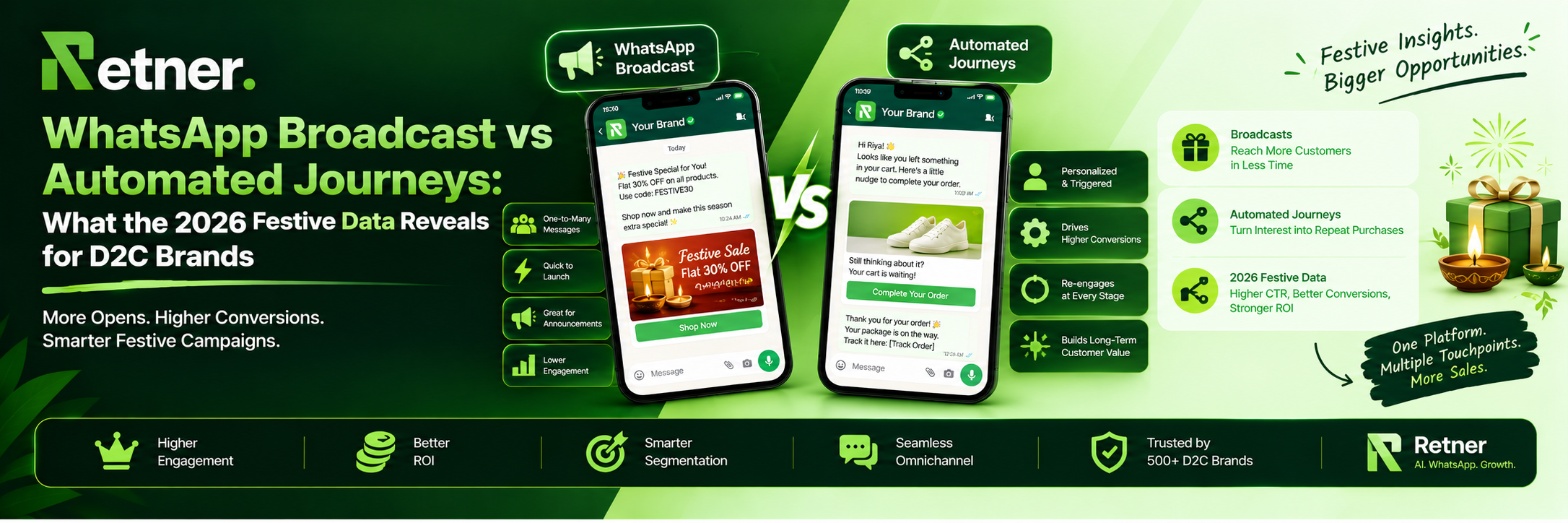
Two pieces of data dropped in October 2026 that every D2C founder needs to see before Diwali on November 8.
The first: India's D2C brands recorded a 31.4% year-on-year rise in shipment volumes during the opening phase of the 2026 festive sale — rising to 4.10 million from 3.12 million in the comparable period last year, with Tier 3 cities accounting for 45% of all shipments.
The second: Automated WhatsApp journeys achieved a click-through rate of 11.1% during the festive quarter. Broadcast campaigns, by comparison, averaged 2.6% CTR.
Those two numbers together tell a clear story.
The festive opportunity is larger than ever — 31.4% more orders, driven by cities your brand may not have optimised for. But the WhatsApp strategy you use to capture that opportunity determines whether you convert first-time festive buyers into long-term customers or into one-and-done transactions that inflate your order count while damaging your unit economics.
The gap between 11.1% and 2.6% is not a rounding error. It is the difference between a campaign that pays for itself and one that burns budget on messages customers ignore.
This guide explains what the data actually means, where broadcast and automation each belong in your festive strategy, and exactly what to do before November 8.
1. What Is WhatsApp Broadcast — and Why Most Brands Over-Rely on It
A WhatsApp broadcast is a message sent simultaneously to a large list of opted-in subscribers — the same message, at the same time, to everyone on the list.
Broadcasts are the most widely used WhatsApp marketing format in Indian D2C — and for good reason. They are fast to set up, require minimal configuration, and create an immediately measurable revenue spike when a well-timed sale announcement goes out.
Used correctly, broadcasts are powerful. Diwali sale launch, Dhanteras flash offer, new product drop — these are genuine broadcast moments where the same message is relevant to almost everyone on your list.
Used incorrectly — which is what most brands do — broadcasts become noise. The same "don't miss out" message goes to VIP customers who deserve early access, at-risk customers who need a win-back message, and new buyers who need onboarding help. None of them receive what they actually need. And the metrics reflect it.
Broadcast campaigns averaged a click-through rate of 2.6%, rising to 3.04% during the festive peak.
That festive peak surge — from 2.6% to 3.04% — tells you that even during Diwali, when purchase intent is at its annual high, generic broadcasts still miss 97% of the people who receive them.
2. What Are Automated WhatsApp Journeys?
Automated WhatsApp journeys are sequences of messages that fire based on specific customer behaviour — not a calendar or a campaign schedule.
A journey starts when something happens: a customer abandons a cart, places a COD order, receives a delivery, goes 45 days without purchasing, or visits a product page three times. The system detects the trigger and sends a precisely timed, contextually relevant message.
Unlike a broadcast — which is one message to many — a journey is many messages to one, each calibrated to what that specific customer has done.
Open rates for automated WhatsApp journeys reached as high as 73.9% during the festive peak.
73.9% open rate. On a channel that already delivers 85–95% opens for transactional messages, behavioural journeys during peak festive intent achieve results that no broadcast campaign can replicate.
The mechanism is simple: a message triggered by something the customer just did is inherently more relevant than a message triggered by what time of year it is.
3. Broadcast vs Automation: The 2026 Performance Data
The GoKwik WhatsApp Commerce Intelligence Report 2026 analysed 26 billion messages sent by more than 1,800 D2C brands across four quarters and documented a clear performance gap between brands using AI-powered automation and those running mass broadcast campaigns.
| Metric WhatsApp Broadcast Automated Journeys | ||
| Average CTR (non-festive) | 2.6% | 11.1% |
| Average CTR (festive peak) | 3.04% | 11.1%+ |
| Open rates (festive) | Moderate | Up to 73.9% |
| Conversion to order | Low | Significantly higher |
| Opt-out risk | High (irrelevant messages) | Low (behaviour-triggered) |
| WhatsApp quality rating impact | Negative at scale | Positive |
| Revenue predictability | Spike-based | Consistent |
| Requires sender reputation | Yes (depletes on over-broadcast) | Yes (preserved by automation) |
The critical insight from the GoKwik report: The recent trend shows a clear move away from bulk broadcast messages, which often get ignored by users. Automation is outperforming broadcast not because broadcast is bad — but because indiscriminate broadcasting to mixed-intent audiences creates message fatigue that damages results for everyone.
4. The 4 Festive Scenarios Where Each Approach Works Best
This is not an argument to abandon broadcast. It is an argument to use each approach for what it is actually good at.
Scenario 1: Diwali Sale Launch Announcement
→ Broadcast wins
When a sale goes live on October 28, the message is the same for almost everyone: "The sale is live, here's what's on offer, here's the link." This is a pure broadcast moment — high relevance, universal applicability, time-sensitive.
What to broadcast:
Send to: Engaged subscribers (opened at least 2 messages in last 60 days). Suppress lapsed and unengaged subscribers — they reduce your CTR and damage your quality rating.
Scenario 2: VIP Early Access (48 Hours Before Public Launch)
→ Automation wins
Your top customers — 5+ purchases or high LTV — should not receive the same sale announcement as everyone else. They deserve a personalised early access message 48 hours before the public launch.
This is an automated journey triggered by: Customer in [VIP Segment] AND [Campaign launch event] = message fires.
What to automate:
For how to build and segment your VIP customer list, see WhatsApp Segmentation for D2C Brands: Right Message, Right Customer.
Scenario 3: First-Time Buyer COD Verification
→ Automation wins (critical)
83% of all WhatsApp-driven orders placed during the festive quarter came from first-time buyers. Most of these first-time buyers will choose COD — because they have not yet established trust with your brand.
Every COD order needs an immediate, automated verification message. A broadcast cannot do this. It requires a trigger-based flow that fires within 2 minutes of order placement, personalised to the specific order, with a prepaid conversion offer.
For the full COD verification cascade including AI voice escalation, see The WhatsApp + AI Voice Cascade: India's Most Powerful COD Automation Flow.
Scenario 4: Cart Recovery During Peak Rush
→ Automation wins
Cart abandonment spikes during festive — customers browse across multiple brands simultaneously, comparing prices, and leaving carts open everywhere. An automated cart recovery message firing 30–60 minutes after abandonment catches the customer at peak consideration.
A broadcast on Monday morning recovering abandoned carts from Saturday night catches customers who have already purchased from someone else, forgotten what they were looking at, or lost interest entirely.
For the complete 3-message cart recovery sequence, see 15 WhatsApp Automation Flows Every Shopify Brand Should Set Up — Flow 3.
5. Why First-Time Festive Buyers Change the Equation
83% of all WhatsApp-driven orders placed during the festive quarter came from first-time buyers.
This single data point has enormous strategic implications that most D2C brands are not acting on.
It means the majority of customers you acquire through WhatsApp this Diwali will have never bought from you before. They will choose COD at higher rates. They will be less forgiving of delivery failures. They will be harder to retain. And they will represent the largest cohort of customers you could convert to loyal repeat buyers — if you have the right automation in place.
A broadcast strategy for festive acquisition addresses the "get them to buy" challenge. An automation strategy for festive onboarding addresses the "make them buy again" challenge.
The two-phase festive WhatsApp strategy that the data supports:
Phase 1 (Acquisition — Pre-Diwali): Targeted broadcasts to engaged segments with sale announcements and festive offers. This drives first-time purchase.
Phase 2 (Retention — Post-Diwali): Automated journeys that kick in the moment a first-time buyer places an order — COD verification, onboarding sequence, review collection, cross-sell recommendation, reorder reminder. This converts first-time buyers into repeat customers.
Most brands execute Phase 1 competently and then go silent for Phase 2. That is why 83% of festive WhatsApp buyers do not repurchase.
6. The Tier 3 Factor: What the Geography Shift Means for Your WhatsApp Strategy
Tier 3 cities accounted for 45% of all D2C festive shipments in 2026, with Tier 2 adding another 22% — meaning two-thirds of festive D2C orders now come from non-metro India.
This geography shift has direct implications for your WhatsApp strategy:
Broadcast language: If two-thirds of your festive buyers are from Tier 2 and Tier 3 cities, a broadcast in English reaches a fraction of them as effectively as a Hinglish broadcast. October is the right time to build your Hinglish broadcast templates if you have not already.
COD dependency: Prepaid share of festive shipments grew from 46% to 52% — but 48% of festive orders are still COD. In Tier 2/3 markets, this proportion is significantly higher. AI voice COD verification in Hindi is not optional for brands with significant non-metro order volumes — it is the only scalable way to manage RTO risk at festive volume.
Automation timing: Tier 2/3 customers have different WhatsApp engagement patterns from metro customers. Evening engagement peaks are slightly later (8–10 PM rather than 7–9 PM). Automated journeys should adjust trigger timing by customer location for maximum open rates.
NDR recovery: With Tier 3 cities accounting for 45% of shipments and delivery infrastructure more variable in these markets, NDR rates spike during the festive period. Automated NDR recovery flows become proportionally more important as geographic distribution expands.
7. Building the Winning Festive Stack: Broadcast + Automation Together
The highest-performing D2C brands do not choose between broadcast and automation. They deploy both — in the right sequence, for the right purpose, to the right segments.
Here is the complete festive WhatsApp stack for the Diwali 2026 window:
Pre-Diwali (Now — October 28): Automation Foundation
These automations must be live before your broadcast campaigns begin. Sending high-volume broadcasts without these in place means converting first-time buyers into RTOs:
✅ COD verification + prepaid conversion — fires on every COD order within 2 minutes ✅ Cart recovery — fires 30–60 minutes after abandonment ✅ NDR recovery — fires within 30 minutes of NDR received ✅ VIP early access journey — fires when VIP segment members receive their early access message
October 28 (Dhanteras Week): Broadcast + Automation Parallel
Broadcast: Sale launch announcement to engaged subscribers Automation: COD verification fires simultaneously for every order placed during the sale
November 8 (Diwali Day): Broadcast One-Shot
Broadcast: Diwali day message — warm festive greeting + final offer Who receives it: All active subscribers — even those who purchased earlier in the sale (Diwali message is a relationship moment, not a sales push)
November 9 Onwards: Full Automation Mode
This is when most brands go quiet. This is when the highest-LTV brands deploy:
First-time buyer onboarding sequence (Days 1, 3, 7 post-delivery) Review collection (Day 3 post-delivery) Cross-sell recommendation (Day 7) Reorder reminder (calibrated to product consumption cycle) Win-back sequence (Day 60 if no second purchase)
For the complete 12 message types used across this stack, see 12 Types of WhatsApp Messages Every D2C Brand Should Be Sending. For the copy-paste templates for every stage, see 20 WhatsApp Message Templates for D2C Brands.
8. What to Do Before Diwali — Right Now
Diwali is 18 days away. Here is what to prioritise this week:
This week (October 21–27):
- [ ] Audit your WhatsApp subscriber list — remove unengaged contacts (no open in 90 days) from your broadcast segment
- [ ] Confirm all festive WhatsApp templates are approved by Meta (submit now if not — approval queues lengthen in October)
- [ ] Activate COD verification + prepaid conversion flow if not live
- [ ] Activate cart recovery automation if not live
- [ ] Build and test your Hinglish broadcast variants for Tier 2/3 subscribers
- [ ] Set up VIP segment early access journey (fires 48 hours before your public broadcast)
Dhanteras week (October 28–November 7):
- [ ] Launch VIP early access (48 hours before public)
- [ ] Send main Diwali sale broadcast to engaged segment
- [ ] Monitor NDR rate daily — festive NDR spikes require same-day response
- [ ] Track COD-to-prepaid conversion rate — increase prepaid incentive if below 10%
Post-Diwali (November 9 onwards):
- [ ] Activate first-time buyer onboarding sequence for all new Diwali customers
- [ ] Build your Day 3 review collection flow
- [ ] Queue your 60-day win-back journey for all first-time Diwali buyers who do not repurchase
For the complete Diwali channel strategy including AI Voice and RCS, see The D2C Diwali Playbook 2026.
Frequently Asked Questions
Should D2C brands use WhatsApp broadcast or automation for Diwali?
Both — for different purposes. Broadcast is right for time-sensitive, universally relevant messages: sale launch announcements, Dhanteras flash offers, and the Diwali day greeting. Automation is right for behaviour-triggered, personalised responses: COD verification (fires on every COD order), cart recovery (fires 30–60 minutes after abandonment), first-time buyer onboarding, and NDR recovery. Automated journeys achieve 11.1% CTR versus 2.6% for broadcasts — but the right answer is not to replace one with the other. It is to use broadcast for what only broadcast can do, and automation for everything else.
What did the 2026 festive data reveal about WhatsApp performance for D2C brands?
Two key findings from October 2026 data: D2C festive shipments grew 31.4% year-on-year, with Tier 3 cities accounting for 45% of all orders. And from GoKwik's WhatsApp Commerce Intelligence Report: 83% of WhatsApp-driven festive orders came from first-time buyers, with brands using WhatsApp automation recording 2.25x higher GMV than brands using broadcast-only strategies. Together, these numbers say the festive opportunity is bigger and more geographically distributed than ever — and capturing it requires automation, not just broadcasting.
How many WhatsApp broadcasts should D2C brands send during the festive season?
For the Diwali window, four to six broadcast messages is the sustainable upper limit: a VIP early access message, a sale launch broadcast, one or two urgency/countdown messages, a Dhanteras special, and a Diwali day message. More than this and opt-out rates spike, damaging your WhatsApp quality rating right before your peak volume window. Complement broadcast volume with automation — automated journey messages do not count toward your "message fatigue" threshold because they are triggered by customer behaviour, not sent proactively.
Why do automated WhatsApp journeys outperform broadcasts?
Because relevance drives results. A message triggered by something the customer just did — abandoning a cart, placing a COD order, receiving a delivery — is inherently more relevant than a message triggered by the time of year. A customer who has just placed a COD order and receives a verification message in 2 minutes is reading a message at peak relevance. A customer who receives a generic "Diwali sale starts tomorrow" broadcast at 10 AM may not have thought about your brand in 30 days.
How does Retner support both WhatsApp broadcast and automation for festive campaigns?
Retner's platform supports both broadcast and automated journeys from a single Shopify-connected dashboard. Broadcast campaigns are built with real-time segmentation — so you send to engaged subscribers only, with the correct Hinglish or English variant by customer location. Automated journeys run 24/7 — COD verification fires within 2 minutes of order placement, cart recovery fires 30–60 minutes after abandonment, and the full post-Diwali onboarding sequence activates automatically for every first-time festive buyer. Both work together as one coordinated festive WhatsApp strategy, not two separate tools.
Ready to build your complete Diwali WhatsApp stack — broadcast + automation + AI Voice — before November 8? Book a free demo →
8x Return On WhatsApp Ads Spend.
Book a demo and we will get you started on proven WhatsApp marketing strategies
Table of Contents
Related Articles
View all
WhatsApp Customer Retention Strategies 2026: 10 Tactics
Learn WhatsApp customer retention strategies for 2026: cart recovery, COD, order updates, replenishment, and winbacks. See examples and KPIs.

Abandoned Cart Recovery Case Study 2026: 5 WhatsApp+AI Tips
Abandoned Cart Recovery Case Study of 5 Indian D2C brands using WhatsApp and AI voice to recover 15–45% revenue and 40–65X ROAS. See message flows.
Ecommerce Customer Retention Strategies: 2026 D2C Guide
Learn Ecommerce Customer Retention Strategies for 2026: WhatsApp automation, COD-to-prepaid, RTO reduction, and lifecycle flows boost repeat sales.