
WhatsApp Chatbot for D2C Brands: How to Automate Sales, Support and Recovery in 2026
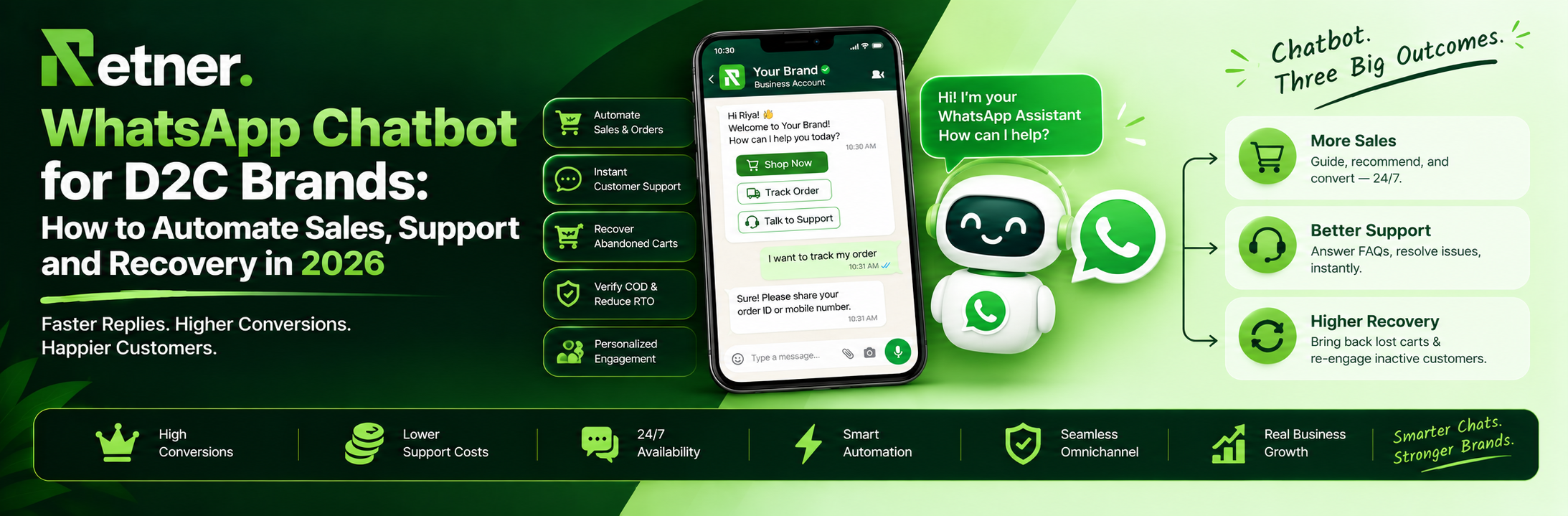
Right now, your support team is answering the same questions they answered yesterday — and the day before that.
"Where is my order?" "Is COD available in my city?" "What is your return policy?" "Can I change my delivery address?" "Do you deliver in 2 days?"
These questions arrive on WhatsApp, on Instagram DMs, and sometimes at 11 PM on a Sunday. Each one takes 2–3 minutes to answer manually. Across 50 daily queries, that is 2+ hours of your team's time — every day — spent on questions that have the same answer every time.
A WhatsApp AI chatbot eliminates this entirely. But that is only the beginning of what it does.
A well-deployed AI support chatbot for Indian D2C brands typically deflects 60–70% of routine enquiries — reducing support costs while improving customer response times from 4–24 hours to 2–5 minutes.
The brands that understand WhatsApp chatbots best are using them not just as a support deflection tool but as an always-on sales engine — recommending products, recovering abandoned carts, verifying COD orders, and upselling — 24 hours a day, across every conversation, without adding headcount.
This guide covers everything a D2C founder needs to know about deploying a WhatsApp chatbot in 2026 — what it is, what it does, how it integrates with your Shopify store, and how to make it smarter with intent-based logic.
1. What Is a WhatsApp Chatbot for D2C?
A WhatsApp chatbot for D2C is an automated conversational system deployed inside WhatsApp Business that responds to customer messages, answers questions, retrieves order data, triggers workflows, and guides customers through buying and support journeys — without requiring a human agent for routine interactions.
The key word is "conversational." A WhatsApp chatbot is not a FAQ page repackaged as a chat window. It responds in real time, in natural language, to whatever the customer types — whether that is "where's my order?" or "I want to return my kurta" or "which serum is better for dry skin?"
Modern D2C WhatsApp chatbots have three layers:
Layer 1 — FAQ and Policy Answers: Pre-programmed responses to common questions — delivery timelines, return policies, COD availability, pincode serviceability. Instant, always accurate, zero agent time.
Layer 2 — Shopify Integration Responses: Live data from your store — order status, tracking ID, cart contents, product availability, customer purchase history. The chatbot pulls this data in real time and presents it conversationally.
Layer 3 — AI-Driven Contextual Responses: For open-ended or complex queries — "which product is better for my skin type?" or "I'm not happy with my order" — a large language model generates a contextually relevant, brand-appropriate response based on your product catalogue and support policies.
2. Rule-Based Bot vs AI Chatbot: What Indian D2C Brands Actually Need
Most brands start with a rule-based bot — a decision tree that says "if customer sends X, reply with Y." These work for simple FAQs but break the moment a customer asks something unexpected.
| Factor | Rule-Based Bot | AI Chatbot |
| Handles unexpected questions | ❌ Falls back to "I didn't understand" | ✅ Generates contextual response |
| Understands Hinglish | ❌ Misses most variations | ✅ Handles Hindi, Hinglish, typos |
| Product recommendations | ❌ Only pre-set options | ✅ Based on preferences and history |
| Order-specific context | Manual lookup required | ✅ Pulls live Shopify data |
| Learns from conversations | ❌ | ✅ Improves with volume |
| Setup complexity | Low | Moderate (simpler with platforms like Retner) |
| Best for | Basic FAQ, simple flows | Full sales + support automation |
For Indian D2C brands with COD complexity, product variety, and Tier 2/3 customers writing in Hinglish — an AI chatbot is not a luxury. It is the only approach that handles the real diversity of what customers actually say.
3. Eight Things a D2C WhatsApp Chatbot Does That Your Support Team Cannot (at Scale)
1. Answers Questions at 3 AM in Hinglish
Your support team is asleep. A customer in Indore just received their NDR notification and messages "mera order kyon return ho gaya?" at 2:47 AM.
An AI chatbot replies immediately — in Hinglish — explains the delivery attempt, and offers three options: reschedule, address update, or cancel. The customer reschedules. The RTO is prevented. No agent involved.
Without a chatbot: the customer either gets no response until morning (by which time the RTO window has closed), or a sleep-deprived team member handles it.
2. Tracks Orders for Every Customer Simultaneously
Abandoned cart recovery via WhatsApp: 25–35% recovery rate. Customer support resolution time: 2–5 minutes on WhatsApp vs 4–24 hours via email.
Order tracking queries — "where is my order?" — are the single highest-volume support query for every D2C brand. A chatbot that pulls live Shopify + courier data handles these instantly for every customer simultaneously. A human agent handles one at a time.
3. Qualifies and Recommends Products in Real Time
"Main dry skin ke liye koi serum dhundh raha hoon jo fragrance-free bhi ho" — this query lands in your WhatsApp. A human agent would need to know your product catalogue deeply to answer well. Your AI chatbot, trained on your catalogue with ingredient lists and skin-type compatibility, recommends the right product, explains why, and sends a direct purchase link — instantly.
4. Handles COD Verification Without a Calling Team
When a COD order comes in, the chatbot sends an immediate confirmation message, captures a YES/NO response to verify intent, and offers the prepaid conversion link with an incentive. Customers who confirm get a seamless order confirmation. Customers who do not respond within 20 minutes trigger the AI voice escalation automatically.
For the full COD verification cascade that the chatbot powers, see The WhatsApp + AI Voice Cascade: India's Most Powerful COD Automation Flow.
5. Recovers Abandoned Carts With Objection Handling
A customer abandoned a cart 35 minutes ago. The chatbot fires a personalised recovery message. The customer replies "yeh thoda expensive hai." The chatbot responds: "Main samajhta hoon! Aapke liye aaj ₹75 off hai — ₹[New Price] mein milega → [Link]"
A human agent would need to be online, read the context, and formulate a response. The chatbot does it in under 2 seconds. For the complete cart recovery flows the chatbot automates, see 15 WhatsApp Automation Flows Every Shopify Brand Should Set Up.
6. Upsells Without Being Pushy
After a customer confirms their order, the chatbot suggests: "Customers who bought [Product A] often also get [Product B] — together they [Combined Benefit]. Add it to your order for ₹[Price]? → [Link]"
This is a zero-cost upsell that happens on every successful order — not just when a human agent remembers to suggest it.
7. Collects Reviews at the Right Moment
Three days after delivery confirmation, the chatbot sends a review request. If the customer responds positively, it sends a direct review link. If they express a concern, it immediately escalates to a human agent — before the frustration becomes a public review.
8. Runs NDR Recovery Before RTOs Happen
The moment an NDR arrives from the courier, the chatbot fires within 30 minutes with three quick-reply options. Using emoji reply options reduces NDR response friction to a single keypress — a customer reschedules their delivery by tapping "1." Without the chatbot: the message goes manually 4–6 hours later, the courier has already marked it as failed, and the RTO process begins.
4. The 5 Use Cases Where WhatsApp Chatbots Deliver the Highest ROI
Use Case 1 — Pre-Purchase Product Discovery
Scenario: Customer types "mujhe oily skin ke liye moisturiser chahiye under ₹600"
Chatbot response: Queries your product catalogue, matches criteria (oily skin-safe + under ₹600 + best-seller), presents 2–3 options with images and key benefits, and sends a direct purchase link.
ROI driver: Every assisted product discovery that ends in a purchase is a conversion that would not have happened without immediate, accurate, personalised guidance. No landing page, no search, no comparison paralysis.
Benchmark: Product recommendation chatbot flows achieve 12–20% purchase conversion from query — significantly higher than a generic website visit.
Use Case 2 — COD Verification and Prepaid Conversion
Scenario: COD order placed → chatbot fires immediately with order confirmation + prepaid offer → customer taps "Pay Online" → conversion to prepaid
ROI driver: Every COD-to-prepaid conversion eliminates RTO risk and reduces logistics cost. At 12–18% conversion rate on the chatbot's prepaid offer, a brand processing 500 COD orders per month converts 60–90 to prepaid every month.
Benchmark: 70–80% COD confirmation rate via chatbot; 12–18% COD-to-prepaid conversion within 5 minutes of order placement.
Use Case 3 — Order Tracking and WISMO Deflection
Scenario: Customer messages "order kab aayega?" → chatbot pulls live Shopify + courier data → responds "Aapka order #45821 kal deliver hoga — Delhivery courier 10 AM - 7 PM ke beech ayega. Track: [Link]"
ROI driver: WISMO (Where Is My Order) queries account for 40–60% of all D2C support volume. Automating 100% of them with the chatbot frees your support team for complex, high-value interactions.
Benchmark: 60–70% support ticket deflection; customer response time drops from 4–24 hours to under 30 seconds.
Use Case 4 — Returns and Exchange Initiation
Scenario: Customer messages "mujhe return karna hai" → chatbot asks for order number → confirms return eligibility → generates return label or picks up request → sends return tracking
ROI driver: A smooth return experience increases repeat purchase probability. A frustrated return experience that required 4 emails and a call creates a churned customer and a negative review. The chatbot makes returns effortless — which is a retention tool, not just a cost centre.
Benchmark: WhatsApp-initiated returns with chatbot handling achieve 18–25% higher second-purchase rates from the returning customer vs form-only return processes.
Use Case 5 — Post-Delivery Upsell and Review Collection
Scenario: Day 5 post-delivery → chatbot sends cross-sell recommendation → customer buys → Day 7 → chatbot sends review request → 4-star review submitted
ROI driver: Two revenue-generating actions (cross-sell + review) that add directly to LTV and social proof — happening automatically for every delivered customer without any manual effort.
Benchmark: Cross-sell chatbot flows achieve 8–15% conversion; review collection via chatbot achieves 30–40% submission rate vs 5–10% for email. For the full message templates used in each of these flows, see 20 WhatsApp Message Templates for D2C Brands — Copy-Paste Ready.
5. Intent-Aware Chatbots: The Next Level
Most WhatsApp chatbots respond to what a customer says. Retner's chatbot also responds to what a customer has been doing — before they even send a message.
This is intent-aware chatbot behaviour — powered by Retner's buyer intent scoring engine.
Standard chatbot: Customer messages "do you have this in blue?" → chatbot answers the question.
Intent-aware chatbot: Customer has visited the product page 3 times in 5 days, added to cart, and removed. They message "do you have this in blue?" → the chatbot answers the question AND notices the high-intent signals → proactively adds "Also, that shade is currently in limited stock — want me to save it for you while you decide?"
The difference: the intent-aware chatbot does not just respond — it acts on the full context of the customer's behaviour to move them toward a purchase decision.
Intent signals that modify chatbot behaviour:
- High visit frequency on a product → chatbot proactively surfaces that product in responses
- Recent cart abandonment → chatbot flags the open cart in any support conversation
- COD history + high RTO pincode → chatbot prioritises prepaid conversion in the verification flow
- Lapsed customer (60+ days) → chatbot applies win-back logic to any incoming query
For a deep-dive into how intent scoring works and what signals Retner processes, see What is Buyer Intent Scoring? How D2C Brands Can Use It to Sell Smarter.
6. When to Escalate — Chatbot to Human Handoff
An AI chatbot should not handle everything. The highest-quality D2C brands use the chatbot for the 60–70% of queries it handles perfectly, and build clean handoff logic for the rest.
Escalate Immediately When:
Customer expresses strong negative emotion. "Main bahut pareshan hoon" or "This is the worst experience" — these require empathy that AI delivers inconsistently. Escalate to a human agent immediately with full conversation context.
The query is complex or legally sensitive. Fraud complaints, disputed charges, bulk order negotiations, influencer partnerships — these require judgment, not automation.
The chatbot has failed twice. If the chatbot has not resolved the customer's query in 2 attempts, escalate. Never let a customer feel trapped in an automated loop.
The customer explicitly asks for a human. "Mujhe human se baat karni hai" — always honour this request immediately. Designing a chatbot to prevent human escalation is a retention disaster.
The Handoff Experience
When escalation happens, the human agent should receive:
- Full conversation history
- Customer name, order number, and recent purchase context
- The specific issue the chatbot could not resolve
- Customer sentiment tag (frustrated, neutral, positive)
With Retner's Omnichannel CRM, this context passes automatically to the agent's inbox — the customer never repeats themselves.
7. How to Set Up a WhatsApp Chatbot for Your Shopify Store
Step 1: Define Your Chatbot's Scope
List the 15 most common questions your support team answers. These become your chatbot's core FAQ training set. Then identify the 5 revenue flows you want automated (cart recovery, COD verification, order tracking, upsell, review collection).
Step 2: Connect Shopify
Retner's Shopify integration gives your chatbot real-time access to order data, product catalogue, customer profiles, and cart activity. This is what enables order-specific responses rather than generic ones.
Step 3: Train on Your Product Catalogue
Upload your product catalogue with key attributes — ingredients, benefits, skin/size/use compatibility, pricing. The AI layer uses this to generate accurate, personalised product recommendations in natural language.
Step 4: Build Your Conversation Flows
Use Retner's no-code flow builder to map:
- The FAQ response flow (pre-programmed answer + escalation trigger)
- The COD verification flow (confirmation + prepaid offer)
- The cart recovery flow (product reminder + incentive)
- The order tracking flow (live data pull + delivery details)
- The return initiation flow (eligibility check + pickup scheduling)
For all the automation flows that integrate with your chatbot, see 15 WhatsApp Automation Flows Every Shopify Brand Should Set Up.
Step 5: Configure Escalation Rules
Define the triggers for human handoff — negative sentiment keywords, repeated resolution failure, explicit human request. Set up your agent inbox so escalated conversations arrive with full context.
Step 6: Configure Intent-Based Behaviour
Connect your chatbot to Retner's intent scoring engine. Define how the chatbot modifies responses based on intent signals — high-intent visitors get more direct purchase nudges, lapsed customers get win-back logic applied.
Step 7: Test and Go Live
Test every flow manually with real customer scenarios — Hinglish queries, unexpected questions, negative sentiment. Record 20 real incoming conversations in week one and identify any gaps. Iterate the training. Most chatbots reach 80%+ autonomous resolution within 30 days of go-live.
Frequently Asked Questions
What is a WhatsApp chatbot for D2C ecommerce?
A WhatsApp chatbot for D2C ecommerce is an AI-powered automated assistant that responds to customer messages inside WhatsApp — answering product questions, tracking orders, verifying COD intent, recovering abandoned carts, initiating returns, and collecting reviews — without requiring a human agent for routine interactions. Modern D2C chatbots integrate directly with Shopify to pull live order data and product catalogue information, enabling accurate, order-specific responses.
How much of D2C customer support can a WhatsApp chatbot automate?
A well-deployed AI support chatbot for Indian D2C brands typically deflects 60–70% of routine enquiries. The remaining 30–40% — complex complaints, nuanced queries, emotionally charged interactions — are escalated to human agents with full conversation context. The chatbot handles every order tracking query, every FAQ, every COD verification, and every standard return request — allowing human agents to focus on high-value, high-judgment interactions.
How does a WhatsApp chatbot reduce RTO for D2C brands?
A WhatsApp chatbot reduces RTO through three mechanisms: (1) immediate COD verification — when a COD order is placed, the chatbot fires within 2 minutes to confirm intent and offer prepaid conversion, achieving 70–80% confirmation rates; (2) NDR recovery — when a delivery attempt fails, the chatbot offers instant rescheduling with numbered quick-reply options, recovering 35–45% of would-be RTOs; (3) pre-delivery address verification — before dispatch, the chatbot confirms the delivery address with the customer, preventing the address-error RTOs that account for 8–12% of total RTO volume.
Can the chatbot handle Hinglish or regional language queries?
Yes. Retner's AI chatbot is trained to understand and respond in Hindi, Hinglish, and common regional language constructions. A customer typing "mera order kahan hai?" receives the same accurate, data-pulled response as a customer typing "where is my order?" The AI layer handles spelling variations, mixed-script inputs, and colloquial phrasing — covering the real language of Indian D2C customers, including Tier 2 and Tier 3 markets.
Is a WhatsApp chatbot different from WhatsApp automation?
Yes. WhatsApp automation sends pre-defined, trigger-based messages outbound — abandoned cart reminders, shipping updates, reorder nudges. A WhatsApp chatbot handles inbound customer messages — responding to whatever the customer says, in real time, with contextual intelligence. The highest-performing D2C WhatsApp systems combine both: automation for proactive outbound journeys, and a chatbot for inbound query resolution. Retner provides both in a single Shopify-connected platform.
How does the chatbot integrate with AI voice calling?
When a COD customer does not respond to the chatbot's verification message within a defined window (typically 20–25 minutes), the system automatically escalates to an AI voice call — without any manual intervention. The voice agent picks up where the chatbot left off, with full context of the order and any chatbot interaction already logged. This WhatsApp-to-voice cascade is the most effective COD management system for Indian D2C brands. For the full cascade flow, see The WhatsApp + AI Voice Cascade.
Want to see Retner's WhatsApp AI chatbot in action for your D2C store? Book a free demo →
8x Return On WhatsApp Ads Spend.
Book a demo and we will get you started on proven WhatsApp marketing strategies