
WhatsApp Segmentation for D2C Brands: How to Send the Right Message to the Right Customer in 2026
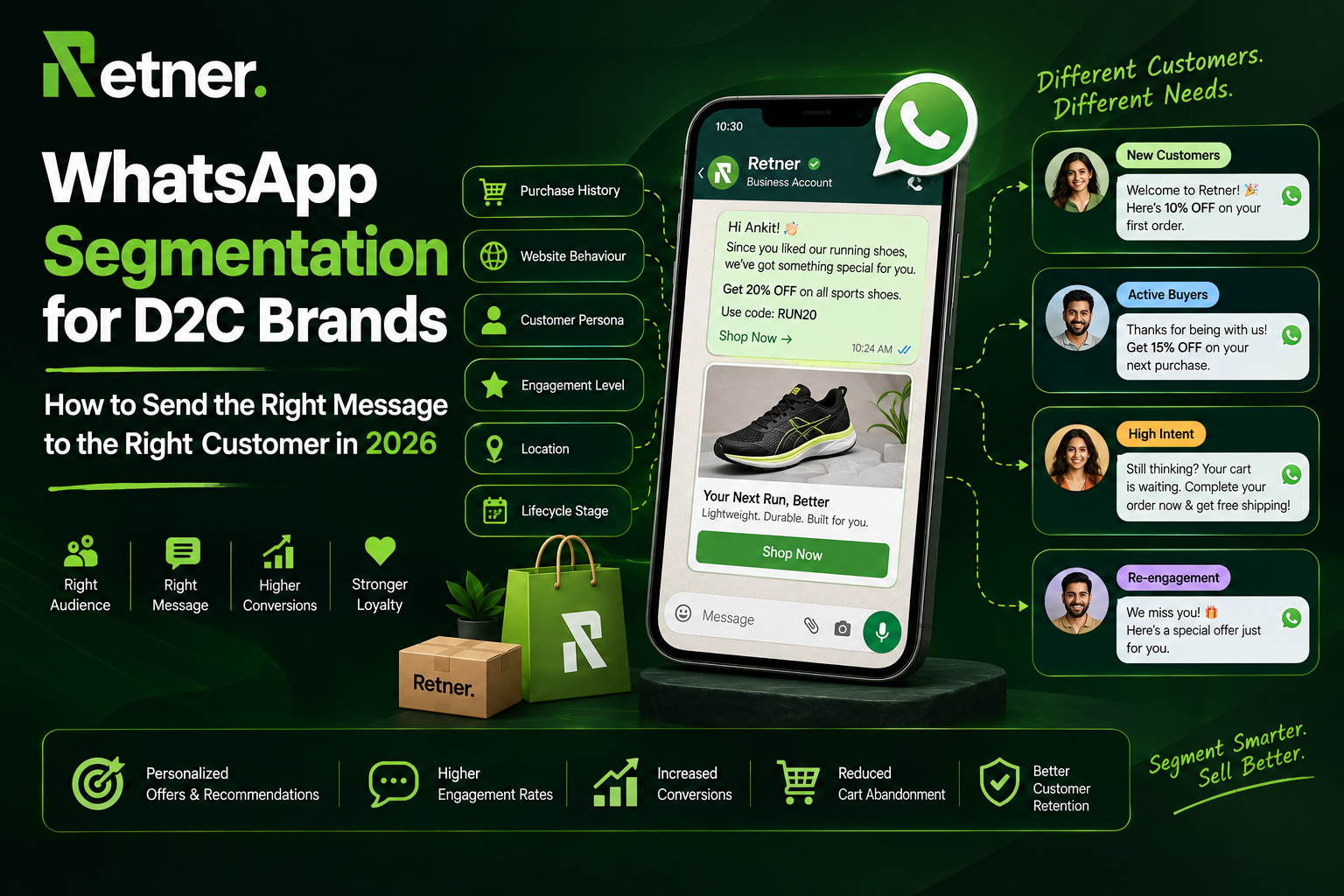
Every D2C brand on WhatsApp is sending messages. Most of them are sending the same message to everyone.
A new customer who bought for the first time three days ago gets the same Diwali sale blast as a lapsed customer who has not purchased in six months. A COD customer with a 35% RTO history gets the same reorder reminder as a prepaid customer who has never returned anything. A VIP customer who spends ₹15,000 per year gets the same generic "don't miss out" message as someone who opened one email eight months ago.
This is not marketing. It is broadcasting — and the difference in results is significant.
The brands outperforming in 2026 are using WhatsApp AI automation to segment their lists before broadcasting — ensuring each recipient receives a message that is relevant to their purchase history, engagement level, and preference profile.
The impact is measurable. Retner's data across 700+ D2C brands shows segmented WhatsApp campaigns deliver 62.2% higher order rates compared to unsegmented broadcasts to the same list.
That gap — 62.2% — is not a marginal improvement. It is the difference between a campaign that pays for itself and one that generates meaningful incremental revenue.
This guide breaks down what WhatsApp segmentation is, the 10 most impactful customer segments for D2C brands, what to send to each, and how to build a segmentation system that updates in real time.
1. What Is WhatsApp Segmentation for D2C?
WhatsApp segmentation is the practice of dividing your customer and subscriber base into distinct groups based on shared characteristics — purchase behaviour, engagement history, COD preferences, lifecycle stage, or product affinity — and sending each group a different, specifically relevant message rather than a uniform broadcast.
The goal is not to send more messages. It is to send better ones — messages that feel personally relevant to the customer receiving them, because they are based on what that customer has actually done.
Demographics rarely tell you enough. Segment by behaviour: product viewed, cart value, category affinity, purchase recency, number of orders, discount sensitivity, COD preference, and email engagement.
A well-segmented WhatsApp campaign might reach only 20% of your total subscriber list. But because that 20% receives a message directly relevant to their current stage and behaviour, the campaign outperforms a blast to 100% of the list — in revenue, in open rates, and in opt-out prevention.
2. Static vs Real-Time Segmentation: The Critical Difference
Most WhatsApp platforms offer static segmentation — you create a list filter, export a segment, and send a campaign. The segment is accurate at the moment you create it. An hour later, it may already be wrong.
A customer you tagged as "cart abandoner" completed their purchase 20 minutes after you ran the filter. A customer in your "active" segment has not engaged in 40 days. Your "lapsed" segment still includes customers who responded to your last campaign.
Real-time segmentation automatically updates segments as customer behaviour changes — so every segment reflects the current state of the customer, not the state they were in when you last manually ran a filter.
| Factor | Static Segmentation | Real-Time Segmentation |
| Accuracy | At time of creation only | Continuously updated |
| Cart abandoner tag | May have already purchased | Auto-removes on purchase |
| Lifecycle stage | Manual reassignment | Automatic on behaviour change |
| Intent signals | Not captured | Updated per session |
| Campaign relevance | Decays over time | Always current |
| Setup effort | High (manual each campaign) | One-time setup, runs automatically |
Retner's segmentation engine updates every customer segment in real time — the moment a customer places an order, their "cart abandoner" tag is removed; the moment a customer goes 60 days without a purchase, they automatically enter the "at risk" segment. No manual intervention required.
3. The 10 Most Powerful Customer Segments for D2C WhatsApp Campaigns
Segment 1 — New Customers (First Purchase, Last 30 Days)
Who they are: Customers who made their first purchase within the last 30 days. At peak brand familiarity but have not yet formed a habit of buying from you.
What they need: Trust-building, onboarding, and a reason to come back before the first-purchase glow fades.
Campaign to run:
- Post-delivery onboarding (Day 1 usage tip)
- Review request (Day 3)
- Cross-sell recommendation (Day 7 — personalised to first purchase category)
- Loyalty programme introduction (Day 14)
WhatsApp message example:
Welcome to the family, {{Name}}! 🎉
You've been with us for 2 weeks — and we want to make sure
you're getting the most out of {{Product}}.
💡 Quick tip: {{Specific Usage Tip}}
We've also added 50 loyalty points to your account.
See your balance → {{Link}}
Benchmark: Brands with a structured new-customer onboarding sequence see 25–35% higher second-purchase rates vs brands with no follow-up.
Segment 2 — Repeat Buyers (2–4 Purchases)
Who they are: Customers who have purchased more than once but have not yet reached loyal status. Building momentum with this segment is critical — each purchase increases the probability of the next.
What they need: Recognition that they are valued, cross-category exploration, and a nudge toward the next tier of your loyalty programme.
Campaign to run:
- Loyalty tier progress update ("You're 1 order away from Gold status")
- Category expansion recommendation (introduce a new product category based on existing purchases)
- Early access to upcoming launches
WhatsApp message example:
You're one step away from Gold status, {{Name}} ✨
{{N}} points earned so far. Gold unlocks:
🎁 Free shipping on all orders
🎯 Early access to new launches
💌 Birthday surprise
Make one more purchase to get there → {{Link}}
Segment 3 — VIP Customers (5+ Purchases or High LTV)
Who they are: Your most loyal, highest-value customers. They know your brand, trust your products, and buy regularly.
What they need: To feel recognised and valued above all other customers. Generic campaigns feel insulting to this segment.
Campaign to run:
- Exclusive early access to new products (24–48 hours before public)
- VIP-only offers that are not available anywhere else
- Personal-feeling messages (not broadcast tone)
- Referral programme invitations (highest-satisfaction segment = highest-quality referrals)
WhatsApp message example:
This is just for you, {{Name}} 🌟
Our new {{Collection/Product}} drops for everyone on {{Date}}.
But you're getting first access — right now, before anyone else.
Your VIP link → {{Private Link}}
This closes at {{Time}}.
For more on how VIP early access works as a retention strategy, see 12 Proven Customer Retention Strategies for D2C Brands.
Segment 4 — At-Risk Customers (30–60 Days Inactive)
Who they are: Customers who were previously active but have not purchased or engaged in 30–60 days. They are drifting — still potentially recoverable but the window is closing.
What they need: A personalised re-engagement nudge — not a generic discount blast. Reference their last purchase or product category to show this is a specifically relevant message.
Campaign to run:
- Personalised check-in ("how is your {{Last Product}} working out?")
- New arrivals in their preferred category
- Moderate incentive (free shipping or 10% off) — save the bigger incentive for the Lapsed segment
WhatsApp message example:
Hey {{Name}}, checking in 👋
It's been a while since your {{Last Product}} order —
hope you're still loving it!
We've got some new arrivals in {{Category}} you might like:
→ {{New Product Link}}
And because we've missed you — free shipping on your next order.
Use code COMEBACK at checkout.
Segment 5 — Lapsed Customers (60–90+ Days Inactive)
Who they are: Customers who have effectively churned. Reactivating them requires more effort and a stronger incentive than the At-Risk segment.
What they need: A genuine win-back campaign — emotionally warm, personal, with a compelling reason to return. Multi-channel approach recommended (WhatsApp → AI Voice → RCS).
Campaign to run:
- Warm WhatsApp win-back (Day 60/90)
- AI voice call if WhatsApp unread (Day 63)
- Final offer message (Day 67)
For the complete win-back cascade flow, see The WhatsApp + AI Voice Cascade.
WhatsApp message example:
We've genuinely missed you, {{Name}} 🙏
It's been {{N}} months since your last order — and we want
to make your return special.
Here's {{X}}% off, just for you → {{Link}}
Valid for 72 hours.
P.S. If something wasn't right last time, reply here.
We want to know. 🙏
Segment 6 — COD Customers (High RTO Risk)
Who they are: Customers whose order history shows a high proportion of COD orders, low prepaid conversion, and potentially a history of NDRs or RTOs.
What they need: Special handling — not exclusion. These customers are often genuine buyers who simply prefer COD. The goal is to verify intent proactively and offer prepaid conversion incentives.
Campaign to run:
- Post-order AI voice verification call (automated, every COD order)
- Prepaid conversion incentive in order confirmation WhatsApp
- Pre-delivery reminder with exact COD amount
This segment should be automatically routed to the AI voice cascade on every new order. For the full COD verification flow, see 12 Types of WhatsApp Messages Every D2C Brand Should Be Sending — specifically Type 6 (COD Order Verification).
Segment 7 — Cart Abandoners (Active in Last 7 Days)
Who they are: Customers with an active abandoned cart — they have added products but not completed checkout within the last 7 days.
What they need: An immediate, direct recovery message. The longer the abandonment goes unaddressed, the lower the recovery probability.
Campaign to run:
- Immediate WhatsApp cart recovery (within 30–60 minutes of abandonment)
- Intent-scored follow-up — High Intent gets AI voice call, Medium Intent gets second WhatsApp
For the full 5-channel cart recovery cascade, see 15 WhatsApp Automation Flows Every Shopify Brand Should Set Up — Flow 3.
Benchmark: Personalised offers and audience segmentation are key WhatsApp marketing best practices for recovering abandoned carts. Segmented cart recovery messages convert at 12–18% vs 6–8% for generic broadcast recovery.
Segment 8 — Product Category Buyers (Category Affinity Segment)
Who they are: Customers whose purchase history shows strong affinity for a specific product category — skincare, supplements, home decor, kids products.
What they need: Category-relevant communication — new arrivals in their preferred category, complementary products within the category, category-specific tips.
Campaign to run:
- New arrivals in preferred category
- "Customers who love {{Category}} also bought..." cross-category introduction
- Category-specific seasonal campaigns (monsoon skincare tips, festive gifting in home décor)
WhatsApp message example:
New in {{Category}} — and it's exactly your vibe, {{Name}} 🌟
Based on what you've loved before, we think you'll want
to see this first: {{New Product Name}}
{{Key Benefit in one line}}
See it → {{Link}}
Segment 9 — Discount-Sensitive Buyers
Who they are: Customers whose purchase history shows they almost exclusively buy during sales, with discount codes, or when there is a special offer. They may have high visit frequency but low conversion at full price.
What they need: Careful handling. Over-discounting trains this segment to wait for the next sale. The goal is to migrate them toward non-discount triggers — urgency (stock limits), exclusivity (limited editions), and value framing.
Campaign to run:
- Limited stock alerts rather than discount messages
- Bundle value framing (the bundle saves money without a discount code)
- Loyalty points campaigns (accumulate points, reduce discount dependency)
What NOT to run: Back-to-back discount campaigns. Each discount conditions them further and erodes margin.
Segment 10 — Replenishment Window (Consumable Buyers)
Who they are: Customers who purchased a consumable product and are approaching the natural refill window based on the product's consumption cycle.
What they need: A timely, frictionless reorder path — not a campaign, just a reminder and a one-tap link.
Campaign to run:
- Timed replenishment reminder (calibrated to product consumption cycle — not a generic 30-day timer)
- Subscription conversion offer (for the highest-frequency consumable buyers)
WhatsApp message example:
Running low on {{Product}}, {{Name}}? 📦
You ordered it {{N}} days ago — most customers find
they start running low around now.
One tap to reorder → {{Reorder Link}}
As a loyal customer: free shipping on this order 🎁
For the full replenishment strategy across all consumable categories, see 12 Proven Customer Retention Strategies for D2C Brands.
4. Suppression Segments: Who You Should Never Message
Smart segmentation is as much about who NOT to message as who to target. These suppression rules prevent WhatsApp spam, protect sender quality rating, and preserve brand relationships.
| Suppression Segment | Rule | Why |
| Recent purchasers (last 24 hrs) | Never send a promotional message within 24 hours of purchase | Over-messaging at peak satisfaction destroys goodwill |
| Open support ticket | Suppress from all campaigns until resolved | Sending a sale message mid-complaint = brand damage |
| Recent NDR / RTO | Suppress from promotional campaigns | Handle operationally before marketing |
| Opted-out subscribers | Hard suppression — never message again | Legal requirement and trust issue |
| Unengaged (no open in 90 days) | Suppress from campaign messages | Damages WhatsApp quality rating, wastes budget |
| Already converted (this campaign) | Remove immediately on purchase | Sending "last chance" to someone who just bought = embarrassing |
Suppression is not a negative action. It is a trust-preserving action. Brands that maintain clean suppression logic preserve their WhatsApp sender reputation, keep opt-out rates low, and ensure that when they do message a customer, the message lands with authority rather than irritation.
5. Segmentation + Intent Scoring: The Complete Picture
Segmentation tells you who your customers are based on historical behaviour. Intent scoring tells you where they are right now in the buying process.
Together, they form the most powerful targeting system available to Indian D2C brands.
Example: Segment 4 (At-Risk Customer) + High Intent Signal (visited product page twice this week)
Without intent scoring: Send a generic win-back campaign on Day 45 of inactivity.
With intent scoring: The moment this at-risk customer visits your product page, their intent score jumps from Low to Medium. The system immediately fires a personalised WhatsApp message based on the specific product they viewed — not a generic win-back offer.
| Historical Segment | + Real-Time Intent Signal | = Campaign Action |
| At-Risk Customer | Visits product page | Immediate product-specific WhatsApp |
| Repeat Buyer | Adds to cart but does not checkout | Cart recovery + loyalty points offer |
| VIP Customer | Visits new arrival page | Early access DM within 30 minutes |
| Lapsed Customer | Returns to website after 60+ days | Immediate win-back message (better timing than Day 90) |
| Replenishment Window | No signal yet | Timed reminder based on consumption cycle |
For a complete guide to how intent scoring works, see What is Buyer Intent Scoring? How D2C Brands Can Use It to Sell Smarter.
6. Building Your Segmentation System in Retner
Retner's segmentation engine is built directly into the campaign builder — segments update in real time as customer behaviour changes, and every WhatsApp automation flow can be filtered to specific segments with a single configuration.
Setting Up Your Core Segments
Step 1: Connect Shopify Retner syncs your full order history and customer data from Shopify automatically. Every purchase, every cart event, every delivery status feeds the segmentation engine.
Step 2: Define Lifecycle Segments In Segments → Lifecycle, configure your time thresholds:
- New: First purchase within last 30 days
- Active: 2+ purchases, last purchase within 60 days
- At Risk: No purchase in 30–60 days
- Lapsed: No purchase in 60+ days
- VIP: 5+ purchases OR total spend above ₹[your threshold]
These update automatically as customers move between stages.
Step 3: Add Behavioural Filters Layer purchase behaviour on top of lifecycle:
- COD preference: % of orders placed as COD
- Category affinity: Most frequently purchased category
- Discount sensitivity: % of purchases made with a discount code
- Engagement rate: WhatsApp open rate in last 90 days
Step 4: Configure Campaign Targeting When building any WhatsApp campaign in Retner, select your target segment from the dropdown. The segment count updates in real time so you always know exactly how many customers will receive the message before sending.
Step 5: Set Suppression Rules In Settings → Suppression, enable:
- Post-purchase suppression window (24 hours)
- Open ticket suppression
- Opt-out hard suppression
- Low-engagement suppression (no open in 90 days)
For the complete template library to deploy across these segments, see 20 WhatsApp Message Templates for D2C Brands — Copy-Paste Ready.
Frequently Asked Questions
What is WhatsApp segmentation for D2C brands?
WhatsApp segmentation for D2C brands is the practice of dividing your customer list into specific groups based on behaviour — purchase history, engagement, COD preference, lifecycle stage, or product affinity — and sending each group a different, specifically relevant message. Retner data shows segmented campaigns deliver 62.2% higher order rates versus unsegmented broadcasts to the same list, because each customer receives a message relevant to their actual current situation.
How is real-time segmentation different from standard segmentation?
Standard segmentation creates a customer list based on filters at a specific point in time — and that list becomes outdated the moment customer behaviour changes. Real-time segmentation continuously updates segment membership as customer behaviour evolves: a customer moves from "cart abandoner" to "purchased" the moment they complete checkout; a customer moves from "active" to "at risk" the moment they pass 30 days without a purchase. Retner's segmentation engine runs real-time updates, ensuring every campaign targets an accurate, current audience.
How many WhatsApp segments should a D2C brand maintain?
Start with five core segments: New Customers, Repeat Buyers, At-Risk, Lapsed, and VIP. These five cover the full customer lifecycle and are immediately actionable. Add the Replenishment Window segment if you sell consumable products, and the COD High-Risk segment if your COD rate is above 40%. The Cart Abandoner segment is handled by your automation flows rather than manual campaigns. Avoid creating more segments than you have distinct campaigns to send — a segment without a dedicated campaign is just noise.
What is the right frequency for messaging each WhatsApp segment?
New Customers: 2–3 messages per week in the first 30 days (onboarding sequence). Active/Repeat Buyers: 1–2 promotional messages per week maximum, plus automated trigger-based messages (replenishment, cross-sell). VIP Customers: 1 exclusive message per week — quality over quantity. At-Risk Customers: 1–2 re-engagement messages over 2 weeks, then escalate to the Lapsed sequence. Lapsed Customers: 3-message win-back sequence over 1 week, then suppress from campaigns until re-activation. Four to eight promotional messages per month is the sustainable range for most brands — more than this and opt-out rates increase significantly.
Does WhatsApp segmentation work for small D2C brands?
Yes — in fact, segmentation is proportionally more impactful for smaller brands because every message and every rupee of campaign cost matters more. A 200-person subscriber list segmented into New, Active, and Lapsed categories will consistently outperform a 200-person list where everyone receives the same message. The minimum viable segmentation for any D2C brand is a simple lifecycle split (New vs Active vs Lapsed) with separate campaigns for each group.
Want to see Retner's real-time segmentation engine in action for your D2C store? Book a free demo →
8x Return On WhatsApp Ads Spend.
Book a demo and we will get you started on proven WhatsApp marketing strategies